
Azure Databricks Machine Learning and AI Engineering for Agencies
White-label ML platform delivery and AI engineering across AU, UK, and SG. We build the Azure Databricks ML stack — your clients get production-grade model training, serving, and monitoring, not notebooks that never ship.
From MLflow experiment governance and Feature Store architecture to serverless Model Serving endpoints, Vector Search for RAG pipelines, and Mosaic AI Agent Framework builds. End-to-end Azure Databricks AI engineering under your agency brand.
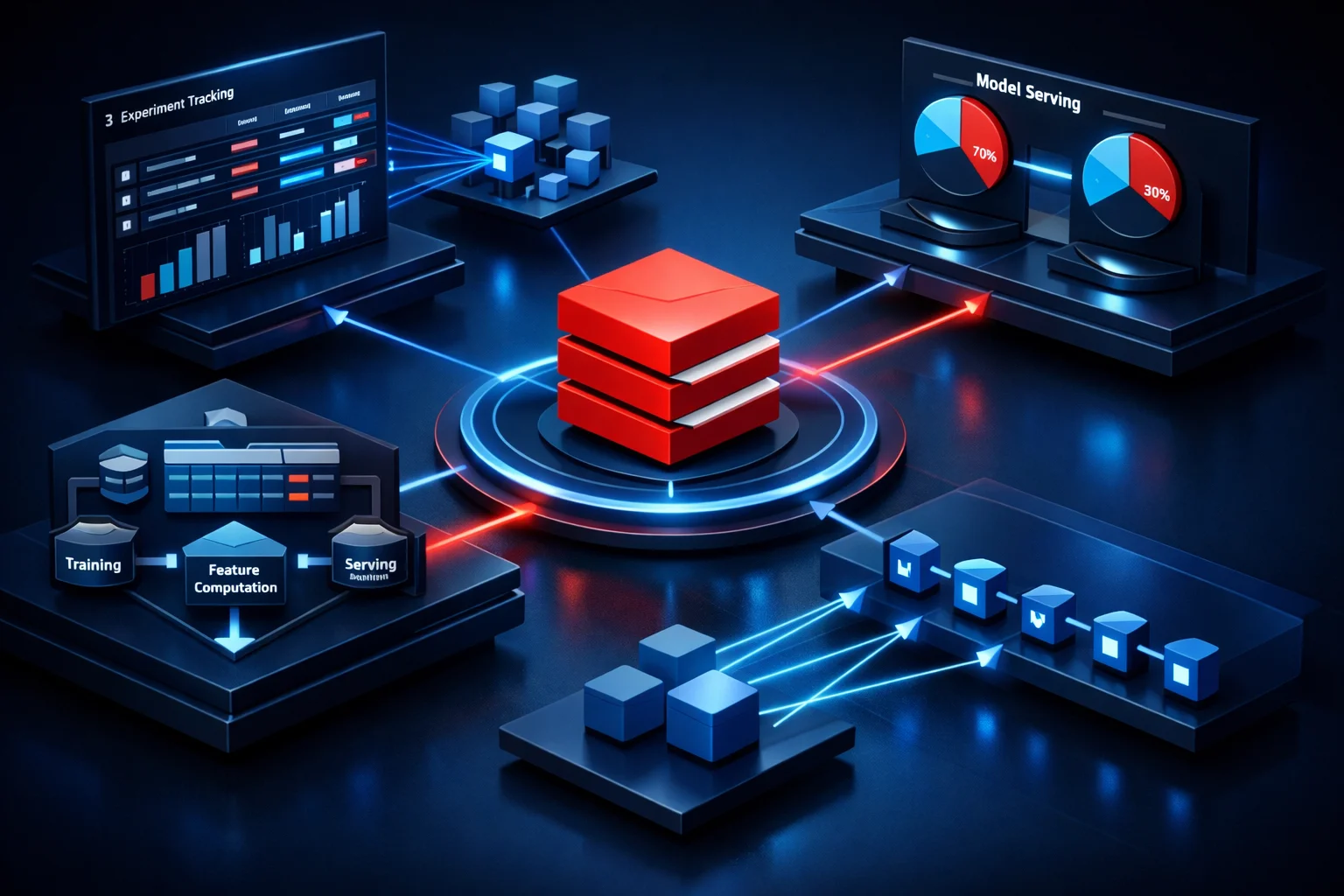
Azure Databricks for ML and AI: What the Platform Gives You — and What You Still Have to Build
Azure Databricks isn’t a turnkey ML platform just because MLflow comes pre-installed. The gap between an Azure Databricks environment where data scientists run experiments in notebooks and one where models reliably ship to production is the MLOps engineering work done in between: structured experiment tracking with naming conventions and mandatory parameter logging, a Feature Store that eliminates training/serving skew, a model registry with approval gates, and a serving infrastructure that handles autoscaling, versioned rollouts, and inference monitoring without manual intervention.
We’ve built enough Azure Databricks ML platforms to know where teams consistently skip the infrastructure. Feature Store gets deferred because it requires upfront schema design. MLflow runs accumulate without organisation and become impossible to compare six months later. Model Serving endpoints get deployed but never monitored for drift. We build the platform layer before training starts — not after the first production incident. See how this approach has delivered for clients across our case studies.
Azure Databricks ML and AI Engineering Services
Six specialist capabilities. One engineering team building the production ML platform your client's Azure Databricks environment actually needs.
MLflow Experiment Tracking and Governance
We configure MLflow experiment hierarchies for your Databricks workspace — naming conventions, run tagging schemas, mandatory parameter and metric logging patterns, and artifact storage routed to Unity Catalog volumes. Autologging is configured for your framework stack: PyTorch, scikit-learn, XGBoost, and HuggingFace transformers. MLflow runs logged without structure become impossible to compare at scale — we establish the governance before the first training job runs, not after six months of unorganised experiment history.
Feature Store Architecture and Pipeline Build
The Databricks Feature Store eliminates training/serving skew by making feature computation logic a shared artifact rather than duplicated code. We design feature table schemas aligned to your entity keys, configure Delta-backed feature tables with the right CDC settings in Unity Catalog, build feature computation pipelines as Databricks Workflows tasks, and implement point-in-time lookups for time-series feature retrieval during training. The serving endpoint and the training pipeline use the same Feature Store lookup — skew becomes structurally impossible.
AutoML and Model Development
Azure Databricks AutoML generates a baseline model with feature importance analysis and tuned experiment notebooks documenting the configuration. We use AutoML as a starting point — running it against your prepared feature set to surface feature distributions and data quality issues — then tune beyond the baseline with MLflow-tracked custom training runs against your specific business metric. AutoML’s output is a diagnostic and a starting benchmark, not a deployment target. Your client’s business problem usually requires the custom training iterations that follow.
Model Serving Endpoint Engineering
Model Serving on Databricks provides serverless real-time endpoints with per-request auto-scaling and GPU-backed classic endpoints for large models. We configure endpoint creation from Unity Catalog-registered model versions, set concurrency limits and traffic routing for canary deployments (90/10 champion/challenger split), pin serving environment library versions to match the training environment, and wire up client authentication via service principal credentials. Serving endpoints are tested under load before your client team receives access credentials.
Vector Search and RAG Pipeline Build
Vector Search indexes Delta Lake tables of embeddings — generated by Azure OpenAI or Databricks-managed embedding models — enabling semantic similarity queries for retrieval-augmented generation pipelines. We design the chunking strategy, select the embedding model, configure the index type (Delta Sync or Direct Access), build the RAG chain connecting Vector Search retrieval to a completion endpoint, and deploy the chain as a Mosaic AI Model Serving endpoint. Your client gets consistent retrieval latency and autoscaling without managing a separate vector database infrastructure.
Mosaic AI Agent Framework Build
The Mosaic AI Agent Framework lets you build LLM-powered agents that call tools, retrieve from Vector Search, execute Python, and chain model calls with state. We build agents using the @chain decorator and ChatModel interface, define tool schemas for your use case (API calls, document lookup, structured output extraction), run agent quality evaluation using mlflow.evaluate() with LLM judge metrics, and deploy to Azure Databricks Model Serving for downstream application integration. Agent evaluation is automated — not manual spot-checking in a notebook.
Our MLOps-First Approach to Azure Databricks ML Delivery
We don’t start by training models. Every engagement begins with MLOps infrastructure design — before any experiment runs. We define the experiment naming hierarchy, the model registration policy and alias promotion workflow, the Feature Store entity schema, the serving endpoint specification, and the monitoring alert thresholds as a documented system before your client’s data science team writes a single training loop. This phase typically takes one week and produces an architecture document that gets reviewed and signed off before implementation begins.
The reason is straightforward: training a model well is easier than building the infrastructure that makes model training reproducible, traceable, and deployable at scale. We build that infrastructure first so every subsequent training run produces outputs that flow through a reliable path from experiment to production. To scope your client’s Azure Databricks ML environment, book a discovery call — we return a scope document within a week.

Technical Capabilities in Every Azure Databricks ML Engagement
Pipeline engineering, model governance, serving architecture, and production monitoring — built in from the start, not retrofitted after the first deployment fails.
ML Pipeline and Training Infrastructure
Databricks Workflows Jobs for parameterised training pipelines with task dependency graphs — data prep, feature lookup, training, and evaluation as independently retryable steps. Cluster configuration pinned to library versions matching the development environment. Training run artifacts logged to Unity Catalog volumes with structured naming. Multi-task job runs that capture the full training lineage as a single trackable Workflow execution.
Model Registry Governance
Unity Catalog model registry integration — model versions registered to a three-level namespace (catalog.schema.model), promotion workflow using aliases (@challenger on registration, @champion after validation gate pass) rather than stage labels. Model lineage records link each registered version to the training run, the feature table versions, and the dataset version used — making every production model traceable back to its exact training provenance in the Azure Databricks workspace.
Real-Time and Batch Serving Architecture
Serverless Model Serving endpoints for real-time inference with auto-scaling concurrency, traffic routing between model versions for canary rollout, and serving environment pinning to avoid library drift between training and serving. Batch inference jobs using mlflow.pyfunc.spark_udf() for scoring large offline datasets against registered model versions without a running endpoint — cost-effective for nightly scoring pipelines that don’t need sub-second latency.
Model Monitoring and Drift Detection
Databricks Lakehouse Monitoring on the inference table — statistical drift detection comparing live prediction distributions against the training baseline, configurable sensitivity thresholds, and custom quality metric calculations over the inference log. Azure Monitor integration for endpoint latency, error rate, and throughput alerts. Drift alerting configured to trigger before model degradation reaches a level that affects downstream consumers or business metrics your client’s team is accountable for.
Azure Databricks ML Engineering Delivered Under Your Agency Brand
We work as the invisible ML engineering layer behind your agency’s Azure Databricks delivery. Our engineers design the MLOps platform, build the Feature Store pipelines, configure Model Serving endpoints, and produce runbooks and governance documentation in your agency’s format. Your clients receive a production-grade ML platform with full documentation — not a collection of notebooks with no deployment path and no operational runbook behind them.
Our white-label development model is built for agencies managing Azure Databricks ML clients at volume. You scope the engagement confidently knowing the platform engineering is handled. For agencies running multiple concurrent AI engineering projects, our agency partner programme provides priority access to our Azure Databricks ML team, preferred project rates, and a dedicated account contact across all active client engagements.

Why Azure Databricks ML Projects Stall Before They Reach Production
The most common failure: training/serving skew caused by feature computation that differs between the training pipeline and the serving endpoint. Training computes features over the full historical dataset with one aggregation window. The serving endpoint recomputes features from the raw request with a different window, different null handling, or a different normalisation. The model evaluates well offline but degrades silently in production because the features it sees at inference time aren’t what it was trained on. The Databricks Feature Store exists precisely to close this gap — but it requires upfront schema design that teams defer under deadline pressure and never come back to.
The second pattern: no MLflow organisation. Databricks ships with MLflow pre-configured, which teams interpret as pre-organised. After six months of model development, MLflow contains hundreds of runs with no naming convention, inconsistent parameter logging, and no way to trace which run produced the model currently serving in production. Our Microsoft Azure development services practice establishes experiment governance and Feature Store schemas before any training starts — not as a cleanup project after the ML team is already six months in.
Engagement Models for Azure Databricks ML Projects
Structured for agency delivery workflows. Scalable across your full AI engineering portfolio.
ML Platform Sprint
A defined 4-to-6-week sprint covering MLOps infrastructure design, MLflow experiment hierarchy setup, Unity Catalog integration, Feature Store schema and pipeline build, and initial Model Serving endpoint deployment. Best for agencies whose clients are starting this ML work and need a production-grade platform foundation before the data science team begins training experiments in earnest.
Dedicated Azure Databricks ML Engineer
A senior Databricks ML engineer embedded in your client project — designing the Feature Store schema, building training pipelines as Workflows Jobs, configuring Model Serving endpoints, and establishing MLflow governance. Operating in your project channels, producing documentation in your format. Available full-time or part-time depending on model development volume and current sprint phase.
MLOps Retainer
A monthly retainer for agencies managing multiple Azure Databricks ML clients simultaneously. Covers model retraining pipeline updates, serving endpoint monitoring, Feature Store schema extensions as new model inputs are identified, and MLflow governance audits. Predictable monthly cost across your active AI engineering portfolio without spinning up a fresh engagement for each change request.
AI Engineering Pod
Two to three Azure Databricks ML engineers building a complete AI platform alongside your client’s data science team — Vector Search for RAG, Mosaic AI agent builds, Model Serving infrastructure, and MLflow governance. Right for clients who have data scientists but need ML engineering capacity to get models off notebooks and into monitored production. Reach us via our contact page to discuss pod structure and start timeline.
Our Azure Databricks ML Delivery Process
Six phases from readiness assessment to production handover, with sign-off gates before each build stage begins.
Phase 1 — ML Readiness Assessment and Platform Design
We assess the current state of your client’s Databricks environment: existing experiment structure, any in-use MLflow tracking, cluster policies, Unity Catalog enablement, and storage configuration for ML artifacts. The output is an MLOps platform design document covering experiment hierarchy, model registry namespace, Feature Store entity scope, serving endpoint specifications, and monitoring architecture — reviewed and signed off before any implementation begins.
Phase 2 — MLflow and Unity Catalog Integration Setup
MLflow experiment hierarchy created under the Unity Catalog namespace, autologging configured for the client’s framework stack (PyTorch, scikit-learn, XGBoost, HuggingFace, or Spark ML), artifact storage routed to Unity Catalog volumes rather than the legacy DBFS root, and model registry configured in Unity Catalog with three-level namespace alignment to the client’s data domain structure. Experiment naming conventions and mandatory tag policies applied before training begins.
Phase 3 — Feature Store Design and Pipeline Build
Feature table schemas designed per primary entity key, Delta-backed feature tables created in Unity Catalog with appropriate CDC settings, feature computation pipelines built as Azure Databricks Workflows task chains, and point-in-time lookup configuration for training datasets that require historical feature retrieval. The serving endpoint lookup is validated against the training lookup before the first model trains against Feature Store data.
Phase 4 — Model Training, Registration, and Governance
Training pipelines built as parameterised Workflows Jobs with mandatory parameter logging, metric collection, and artifact storage to Unity Catalog volumes. Model registration from training runs into the Unity Catalog model registry with @challenger alias assignment. Promotion workflow documented — from challenger evaluation against the @champion baseline to alias swap on validation gate pass. No model reaches the serving endpoint without passing the evaluation gate.
Phase 5 — Serving Endpoint and Inference Pipeline Deployment
Model Serving serverless endpoint provisioned for the champion model version, traffic routing configured for canary deployment, batch inference job created using mlflow.pyfunc.spark_udf() for offline scoring use cases, and serving endpoint authentication tested with service principal credentials before client team access is granted. Endpoint load tested at expected peak concurrency before production traffic is routed.
Phase 6 — Monitoring, Alerting, and Knowledge Transfer
Lakehouse Monitoring profiles configured on the inference table — baseline distribution from training data, drift sensitivity thresholds, and custom business metric calculations. Azure Monitor alert rules set for endpoint latency and error rate. MLflow experiment governance guide, Feature Store schema documentation, model registry promotion runbook, and monitoring alert response playbook delivered. Learn more about how we structure all engineering delivery on the NextEnvision Digital homepage.
Azure Databricks ML and AI — Frequently Asked Questions
Honest answers to the questions agencies ask us before taking on a client's Azure Databricks ML project.
What security requirements should Android Kotlin development address?
The Databricks Feature Store is a centralised repository for feature computation logic and feature values, backed by Delta Lake tables in Unity Catalog. It eliminates training/serving skew by making the same feature transformation code a shared artifact used by both the training pipeline and the serving endpoint. Without it, features computed differently in training versus serving cause models to evaluate well offline but degrade silently in production. The Feature Store also enables point-in-time lookups for time-series features and records lineage linking registered model versions to the exact feature tables used in training.
How is WCAG 2.1 accessibility implemented in Android Kotlin development?
Serverless Model Serving endpoints auto-scale to zero between requests — you pay only for active inference time with no minimum cluster cost. Classic (GPU-backed) endpoints use dedicated clusters that stay running, with reserved capacity for GPU-accelerated inference on large models. Serverless is the right choice for most API-style model serving where request volume is variable or unpredictable. Classic endpoints suit large LLMs requiring GPU acceleration, high-throughput workloads with consistent volume, or cases where always-on cluster cost is lower than serverless per-request pricing at sustained traffic levels.
How does Hilt dependency injection work in Android Kotlin development?
When Unity Catalog is enabled, the MLflow Model Registry uses Unity Catalog’s three-level namespace — catalog, schema, model name — for storage and access control. Models inherit catalog and schema-level permissions, replacing the legacy Workspace Registry’s workspace-level ACLs. Model versions are promoted using aliases (@challenger, @champion) rather than stage labels, and each version records lineage back to the MLflow training run, the Feature Store tables, and the dataset version used — making every production model fully traceable.
What is ProGuard/R8 and why does Android Kotlin development need it?
Databricks Vector Search indexes Delta Lake tables containing text embeddings — vectors generated by Azure OpenAI or Databricks-managed embedding models. It supports Delta Sync indexes (automatically synced from a Delta table) and Direct Access indexes (updated via REST API). Vector Search powers the retrieval step in a RAG pipeline — finding the most semantically relevant document chunks for a given query, which are then passed alongside the user query to an LLM completion endpoint to generate a grounded answer without hallucinated content.
How does Android Kotlin development handle errors and offline states?
Databricks Lakehouse Monitoring runs statistical analysis on your model’s inference table — the log of inputs and predictions captured by Model Serving or a batch scoring job. It computes distribution drift metrics comparing live prediction distributions against a training baseline and triggers Azure Monitor alerts when drift exceeds configured thresholds. You can also define custom quality metrics that compare predictions against delayed ground truth labels as they become available — detecting accuracy degradation in addition to input distribution drift.
How do you evaluate and select third-party libraries for Android Kotlin development?
That’s our standard delivery model. We design the MLOps platform, build the Feature Store pipelines, train and register models, configure Model Serving endpoints, and set up monitoring — operating entirely within your project channels and producing documentation in your agency’s format. Your clients receive a production-grade Azure Databricks ML platform with full governance runbooks and handover documentation. Agencies managing multiple AI engineering clients through us typically move to our agency partner programme for priority ML team access and consolidated commercial terms.