
Android App Development with Kotlin
Architecture is the decision that determines everything else. Kotlin Android apps built on Clean Architecture, MVVM, and typed state management survive production. Apps built without them do not.
NextEnvision designs and delivers Android applications using Kotlin with Clean Architecture, MVVM and MVI state management, a structured repository and domain layer, and Hilt-powered dependency injection that makes every layer independently testable. For agencies in Australia, the United Kingdom and Singapore that commission Android Kotlin development for clients, architectural quality determines maintenance cost, defect rate, and the ability to extend the application after the initial delivery. We treat architecture as a first-class deliverable, not an internal implementation detail.
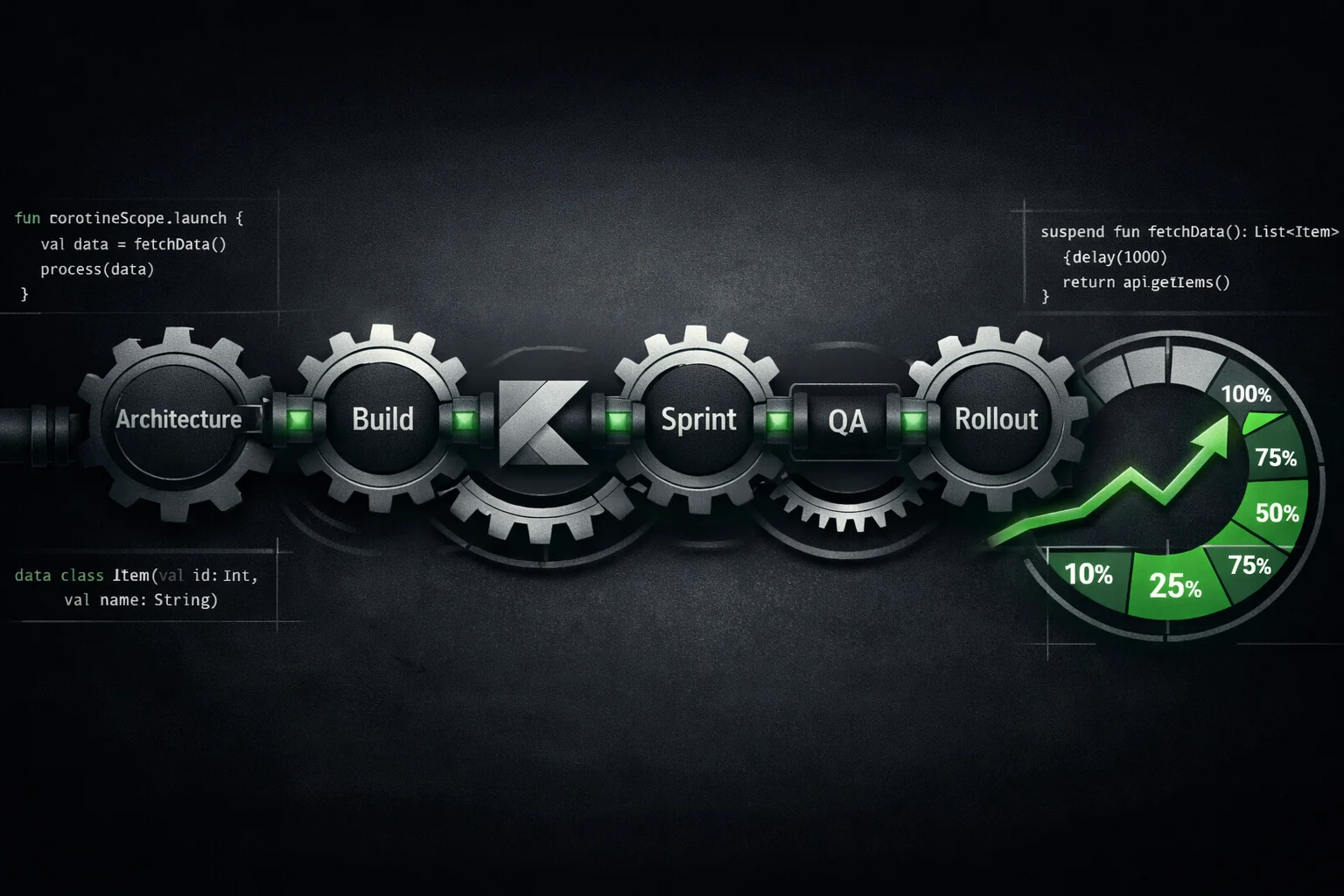
What Android App Development with Kotlin Architecture Actually Covers
Android app development with Kotlin architecture is the discipline of designing the internal structure of an Android application so that business logic, UI state, data access, and dependency management are separated into distinct, independently testable layers with explicit boundaries and typed data flows between them. Architecture is not a pattern choice made once at project start. It is a set of decisions that determine how every subsequent feature is implemented, how every bug is isolated and fixed, and how much a new developer needs to understand before contributing a correct change to the codebase.
The standard architecture for Kotlin Android app development is Clean Architecture applied to the Android platform: a presentation layer built on Jetpack Compose with ViewModels that manage UI state as sealed class hierarchies, a domain layer containing use cases that encapsulate individual business operations and depend on repository interfaces, and a data layer containing repository implementations that coordinate network, local database, and cache data sources. This separation produces a codebase where every ViewModel is unit-testable without a running Android device, every use case is testable with fake repository implementations, and every data source is replaceable without changing any code above the data layer boundary.
NextEnvision applies this architectural standard to every Android Kotlin app development engagement for businesses and agencies in Australia, the UK and Singapore, from single-screen productivity tools to multi-module enterprise applications with offline-first requirements.
Android App Development with Kotlin Architecture Services
Six Kotlin Android architecture services targeting the structural decisions that determine long-term application quality, testability, and team maintainability.
Clean Architecture Layer Design for Kotlin Android
We design the three-layer Clean Architecture structure for Kotlin Android applications: presentation layer with Jetpack Compose screens and Kotlin ViewModels, domain layer with use case classes and repository interfaces, and data layer with repository implementations, Room DAOs, Retrofit service interfaces, and data source coordinators. The domain layer has no Android dependencies and is compiled as a pure Kotlin module. The presentation layer depends only on domain interfaces. The data layer implements domain interfaces and is the only layer that knows about network or database implementation details. This structure makes the entire domain and presentation layer unit-testable with the JVM alone, without requiring an emulator or Android instrumentation.
MVVM and MVI State Management Architecture
ViewModel state management in Kotlin Android app development requires choosing between MVVM and MVI depending on screen complexity and team preferences, then applying the chosen pattern consistently across every screen. We implement MVVM with StateFlow-backed ViewModels that expose a single UiState sealed class per screen, and MVI with an intent-to-state reduction pipeline that processes user actions as typed Intent objects, applies them to the current state in a pure reduce function, and emits the resulting state to the Compose UI. Both patterns produce ViewModels that are fully unit-testable with TestCoroutineDispatcher and Turbine for Flow assertions, without requiring any Compose rendering or Android lifecycle involvement in the test.
Repository Pattern and Data Layer Architecture
The repository pattern in Kotlin Android app development is the boundary between the domain layer and the data sources. We implement repositories as interface definitions in the domain layer with concrete implementations in the data layer that coordinate a remote data source using Retrofit, a local data source using Room, and an in-memory cache using Kotlin StateFlow or a simple data class. The repository decides whether to serve data from the cache, the local database, or the network based on the data’s age, the device’s connectivity state, and the force-refresh signal from the use case. This coordination logic lives in the repository implementation and is hidden from both the domain layer and the presentation layer.
Kotlin Coroutines and Flow Architecture
Kotlin coroutines and Flow are the async primitive layer of Android Kotlin app development. We implement structured concurrency with coroutine contexts assigned deliberately: IO dispatcher for all network and database operations, Default dispatcher for CPU-intensive transformations, and Main dispatcher only for UI updates. Repository methods return Flow for observable data streams and suspend functions for one-shot operations. ViewModels collect repository Flows using viewModelScope so collection is automatically cancelled when the ViewModel is cleared. Use cases transform repository Flows with map, flatMapLatest, combine, and debounce operators without adding intermediate StateFlow collectors that introduce unnecessary buffering and lifecycle complexity.
Hilt Dependency Injection Module Architecture
Hilt dependency injection architecture in Kotlin Android app development defines how every class in the application receives its dependencies without creating them directly. We design the module structure before any implementation code is written: a NetworkModule providing the OkHttpClient, Retrofit instance and service interfaces at SingletonComponent scope, a DatabaseModule providing the Room database and DAOs at SingletonComponent scope, a RepositoryModule binding repository interfaces to implementations at SingletonComponent scope, and a UseCaseModule providing use case instances at ViewModelComponent scope so each ViewModel receives a fresh use case instance scoped to its lifecycle. This structure is documented in the Architecture Decision Record so every team member knows which scope a new dependency belongs in.
Android Kotlin App Architecture Audit and Refactoring
Existing Android Kotlin applications frequently accumulate architecture debt: ViewModels that access network APIs directly, use cases that import Android SDK classes, repositories that expose exceptions instead of typed errors, and Hilt modules that provide everything at Singleton scope regardless of the correct lifecycle. We audit existing Kotlin Android codebases against Clean Architecture principles, document every violation with severity and effort-to-fix estimates, and execute refactoring in a sequence that keeps the production application functional throughout. The audit report is delivered before any refactoring begins and reviewed with your team to agree the prioritised remediation plan.
The Kotlin Android Architecture Pattern Decision Framework
Every Kotlin Android app development project requires a documented decision on three architecture questions before the first class is written. The first question is whether to implement MVVM or MVI at the presentation layer. MVVM with StateFlow is simpler to implement and is the right choice for most applications where screens have moderate state complexity. MVI is the right choice for screens with complex user interaction sequences, undo-redo requirements, or where the product team needs deterministic UI state replay for analytics or testing. The second question is how to structure the domain layer use cases: one use case class per operation, or a use case interface with multiple implementations for different contexts. Single-class use cases are sufficient for most Kotlin Android applications. Interface-based use cases are appropriate when the same operation must behave differently in production and test environments or when A/B testing requires multiple business logic implementations at runtime.
The third question is the data layer caching strategy: cache-first with network refresh on staleness, network-first with cache fallback on failure, or cache-only with explicit user-triggered refresh. Each strategy produces different offline behaviour and different UI complexity in the loading and error states. We document the decision for each repository in the Architecture Decision Record with the rationale tied to the specific data type and user expectation. Agencies in Australia, the UK and Singapore that engage NextEnvision for Android Kotlin app development receive this decision document before development begins so the architectural choices are visible, reviewable, and transferable to any future development team.

Four Architecture Engineering Disciplines in Kotlin Android App Development
Kotlin Android Architecture Testability Engineering
Compose UI State Architecture
Testability is the measurable output of correct Android Kotlin app architecture. An application with a correct Clean Architecture implementation has ViewModels that are fully unit-testable with JUnit and Turbine, use cases that are testable with fake repository implementations that return controlled data without network or database involvement, and repository implementations that are testable with a fake data source that bypasses Retrofit and Room. We configure the test architecture at the start of every Android Kotlin app development engagement: a fakes package in the test source set containing fake repository and data source implementations for every domain interface, a test coroutine dispatcher that replaces the production dispatchers so coroutines execute synchronously, and Hilt test modules that replace production bindings with test doubles in instrumented tests.
Navigation Architecture and Deep Linking
Compose UI state architecture in Android Kotlin app development requires every screen’s ViewModel to expose a single UiState object that represents every possible visual state the screen can be in: loading, success with content, empty, and each distinct error category. The Compose screen observes this single StateFlow and renders the correct composable for each state without conditional logic spread across multiple observer calls. Screen-level events that do not persist in state, such as navigation to another screen or showing a snackbar, are modelled as a separate SharedFlow of UiEvent objects that the screen collects in a LaunchedEffect with a lifecycle-aware collector, preventing events from being re-emitted after process death and restoration.
Offline-First Data Architecture
Navigation architecture in Android Kotlin app development using Jetpack Compose Navigation requires a typed route definition strategy that prevents navigation arguments from being passed as raw strings. We define navigation routes as sealed classes or data classes with typed argument properties, generate route strings from the type-safe definitions, and implement deep link patterns for every screen that must be reachable from a push notification or from a URL intent. The navigation graph is structured so that each feature’s screens are contained in a nested navigation graph with a single entry point, which enforces navigation encapsulation and allows feature modules to define their own graphs without the app module needing to know the internal route structure of each feature.
Multi-Module Architecture and Build Organisation
Offline-first data architecture in Android Kotlin app development uses Room as the single source of truth for data that must be available without network connectivity. The repository emits a Flow from the Room DAO as the primary data stream, triggers a network refresh when the cached data is stale or absent, writes the network response into Room, and lets the DAO Flow emit the updated data automatically. Write operations made while offline are queued as WorkManager tasks with network connectivity constraints and executed when connectivity is restored. The ViewModel receives a single unified data stream and never needs to coordinate between a network result and a database result directly.
White Label Android App Development with Kotlin for Agencies
Agencies delivering Android Kotlin app development to clients in Australia and the UK need an engineering partner that delivers architecture documentation alongside working code. A white label Android Kotlin application delivered without an Architecture Decision Record forces the agency to explain architectural choices they did not make, and forces the end client’s future development team to reverse-engineer the architecture from the codebase. Our white label Android Kotlin app development includes full architecture documentation: module graph, dependency injection module structure, ViewModel state management pattern, repository interface definitions, data layer caching strategy, and Detekt configuration, all delivered as a written Architecture Decision Record under your agency brand.
The white label arrangement covers the complete Android Kotlin app development engagement under your agency brand. Mutual NDA before any client brief is shared. Kotlin source code, architecture documentation, Gradle project configuration, and Play Store submission materials are delivered under your brand with zero NextEnvision identifiers anywhere in any deliverable. Complete IP transfer on project completion. AEST and GMT coverage for Australian and UK agency clients. See our white label development and agency partner programme pages for full engagement details.

Why Android Kotlin App Architecture Debt Compounds Faster Than Feature Debt
Architecture debt in Android Kotlin app development compounds differently from feature debt. A missing feature has a known scope and a fixed implementation cost. Architecture debt has a multiplying cost: every new feature added to an incorrectly structured Kotlin Android application takes longer to implement than the previous feature, because each feature requires working around the structural constraints that the incorrect architecture imposes. A ViewModel that accesses the network API directly cannot be unit-tested without a running server. A repository that returns raw exceptions cannot have new error categories handled correctly without modifying every caller. A domain layer that imports Android SDK classes cannot be reused in a Kotlin Multiplatform module. A codebase with no Hilt module documentation accumulates Singleton-scoped dependencies for every new injection regardless of the correct lifecycle.
The inflection point where architecture debt makes feature delivery significantly slower typically occurs between sprint 6 and sprint 12 in a Kotlin Android app development project that did not invest in architecture during the discovery phase. By that point, the cost of continuing to build on the incorrect architecture is lower than the cost of the refactoring required to fix it, and the project team accepts the accumulating slowdown rather than halting feature delivery for a refactoring sprint. The consequence for agencies is a maintenance retainer that costs more than it should, a client relationship that deteriorates as the application becomes harder to change, and a codebase that is practically unmaintainable by any team other than the one that wrote it. NextEnvision applies the correct architecture from sprint one in every Android Kotlin app development engagement to prevent this outcome.
Android Kotlin App Development Engagement Models by Project Starting Point
Greenfield Android Kotlin App Development with Full Architecture Design
Android Kotlin Architecture Audit for Existing Applications
A new Android Kotlin application built with Clean Architecture, MVVM or MVI state management, typed repository pattern, Hilt dependency injection, and structured coroutines applied from sprint one. The discovery phase produces an Architecture Decision Record before any code is written. The library evaluation is completed before any package enters the Gradle version catalog. The test architecture is configured in week one so every ViewModel is testable from the first sprint. Architecture documentation is delivered as a transferable written document, not as institutional knowledge held by the development team.
Architecture Refactoring Engagement
An existing Android Kotlin application assessed against Clean Architecture principles. The audit covers: presentation layer analysis for ViewModels that access data sources directly, domain layer analysis for Android SDK dependencies that prevent JVM-only testing, data layer analysis for repositories that return raw exceptions instead of typed errors, dependency injection analysis for incorrect scoping and service locator anti-patterns, and coroutine architecture analysis for unstructured concurrency and missing cancellation handling. The written audit report ranks findings by severity and provides effort estimates before any refactoring begins.
Kotlin Android Architecture Refactoring Engagement
A targeted Android Kotlin development engagement that addresses a specific architecture gap: migrating a ViewModel-less activity-based architecture to MVVM with Compose, converting exception-throwing repositories to Kotlin Result return types, restructuring a single-module application into a multi-module Clean Architecture with feature, core and data modules, or implementing Hilt dependency injection in a codebase currently using manual dependency wiring or a service locator. Refactoring is executed incrementally with the production application remaining functional, using feature flags where the refactoring changes observable application behaviour.
Android Kotlin Architecture Maintenance Retainer
A structured monthly retainer covering Kotlin and Jetpack library version compatibility management, Architecture Decision Record updates as new features require architectural decisions, Compose Navigation library migration support as Jetpack releases new navigation APIs, Coroutine version updates and structured concurrency review as new Kotlin coroutine APIs replace deprecated patterns, and code quality monitoring through Detekt with new rule evaluation for each Kotlin version update. Agencies with multiple Android Kotlin client applications benefit from consolidating architecture review under a shared retainer. Contact us via the contact page to discuss portfolio options.
How Architecture Is Applied Throughout Android Kotlin App Development
Discovery: Architecture Decision Record and Module Graph Design
Data Layer: Repository and Domain Interface Design
The Android Kotlin app development discovery phase produces the Architecture Decision Record before any code is written. This document defines: the module graph and the dependency rules between modules, the ViewModel state management pattern with the rationale tied to screen complexity, the repository interface definitions for every data domain with the caching strategy per repository, the Hilt module structure with scope assignments for each dependency type, the coroutine dispatcher assignment strategy, and the Detekt configuration with the project-specific rule set. Every architectural decision in this document is agreed with the agency or client before development begins and serves as the reference for every architectural question raised during the development sprints.
Presentation Layer: ViewModel and UiState Implementation
The data layer is the first code written in an Android Kotlin app development engagement. Repository interfaces are defined in the domain module as Kotlin interfaces with suspend function or Flow return types. The data layer implements these interfaces with a concrete repository class that coordinates the remote data source, the Room DAO, and the in-memory cache. Typed error domains are defined as sealed class hierarchies in the domain module. Every repository method returns a Kotlin Result type wrapping the domain object or a typed domain error. The Retrofit service interface and Room DAO are tested in isolation with a mock web server and an in-memory Room database before the repository implementation is written.
Domain Layer: Use Case Design and Business Logic Isolation
Presentation layer implementation in Android Kotlin app development begins with the UiState sealed class definition for each screen. Every visual state the screen can be in is represented as a sealed class variant: Loading, Success with the domain data as a property, Empty, and each distinct error category as a separate Error variant with the user-facing message and the available action. The ViewModel processes user actions as functions, calls the appropriate use case, maps the Result return type to the correct UiState variant, and emits it through a StateFlow. ViewModels are unit-tested with a fake use case that returns controlled Results, a TestCoroutineDispatcher that makes coroutines execute synchronously, and Turbine for asserting StateFlow emissions in sequence.
CI Integration: Architecture Compliance and Test Gates
Domain layer use cases in Android Kotlin app development encapsulate one business operation per class and depend only on the repository interfaces defined in the same domain module. A use case receives its repository dependency through constructor injection and has a single invoke operator function that accepts the operation parameters and returns a Result type. The use case may transform, filter, combine, or validate the repository result, but it never accesses Android SDK classes, network classes, or database classes directly. This constraint keeps the domain module compilable as a pure Kotlin JVM module with no Android Gradle plugin dependency, which means every use case is testable with a plain JUnit test without the Android test runner.
Post-Launch: Architecture Compliance Monitoring
The CI pipeline applies architecture compliance gates that prevent structural violations from reaching the main branch. Detekt with Clean Architecture forbidden import rules runs on every pull request, failing the build if a domain module class imports an Android SDK class or if a presentation layer class imports a data layer implementation class. Module dependency graph verification confirms that no module dependency cycle has been introduced. Unit test coverage thresholds on new code prevent ViewModel and use case logic from being merged without corresponding test coverage. The architecture compliance report is included in every pull request comment alongside the test coverage report. Visit our case studies page for delivered architecture examples.
Post-Launch: Architecture Evolution Support
After Android Kotlin app launch, architectural decisions made during development require revisiting as Jetpack library versions evolve. Compose Navigation releases new type-safe navigation APIs that replace string-based routes. Kotlin coroutines deprecate operators that the application uses. New Jetpack Compose Compiler versions change the stability rules that affect recomposition performance. We provide post-launch architecture support that reviews each Jetpack release for migration requirements, updates the Architecture Decision Record to reflect new decisions made during feature development, and maintains the Detekt configuration to include new Kotlin-specific rules introduced in each Detekt release.
Android App Development with Kotlin: Architecture FAQs
Questions about Clean Architecture, MVVM, MVI, repository pattern, use cases, and testability in Kotlin Android app development.
What is Clean Architecture in Android Kotlin app development?
Clean Architecture in Android Kotlin app development is a structural pattern that separates the application into three layers with a strict dependency rule: the domain layer at the centre defines the business logic and repository interfaces with no Android dependencies, the data layer implements the domain repository interfaces with Retrofit and Room, and the presentation layer implements Compose screens and ViewModels that depend on domain use cases. The dependency rule requires that every dependency points inward. This rule produces a codebase where every domain and presentation class is testable with the JVM alone, without an Android emulator or real network and database instances.
What is the difference between MVVM and MVI in Android Kotlin development?
MVVM in Android Kotlin app development exposes UI state as a StateFlow from the ViewModel and allows the Compose screen to observe it and render accordingly. The ViewModel has separate functions for each user action, and each function updates the StateFlow independently. MVI models all user actions as typed Intent objects processed by a reduce function that takes the current state and the intent and returns the new state, making the state machine explicit and reproducible. MVVM is simpler and sufficient for most screens. MVI is more appropriate when screen state has many interdependent properties that change together in response to complex user interaction sequences, when state replay is required for testing or analytics, or when the team explicitly wants the constraint that state changes only happen through the reduce function.
Why do Android Kotlin app ViewModels use sealed classes for UI state?
Sealed classes in Android Kotlin app development represent every possible visual state a screen can be in as a closed hierarchy of types. A Loading object, a Success data class with the content as a property, an Empty object, and distinct Error subclasses for each error category. The Compose screen uses a when expression over the sealed class to render the correct composable for each state, and the Kotlin compiler enforces exhaustiveness: if a new state variant is added to the sealed class, every when expression in the codebase that processes this state must handle the new variant or the build fails. This compile-time check prevents the missing-state bugs that are the most common cause of blank screens and unhandled error states in Android Kotlin applications using boolean flags instead of sealed class state.
How does the repository pattern work in Android Kotlin app development?
The repository pattern in Android Kotlin app development defines a repository interface in the domain layer with suspend functions for one-shot data operations and Flow return types for observable data streams. The data layer implements this interface with a concrete class that has three dependencies: a remote data source wrapping the Retrofit service interface, a local data source wrapping the Room DAO, and an optional in-memory cache. When the ViewModel calls a use case that calls the repository, the repository decides whether to return cached data, trigger a network request and cache the result, or return a local database Flow and trigger a background network refresh. This coordination logic lives in the repository and is hidden from both the domain and presentation layers.
Do you offer white label Android Kotlin app development for agencies?
Yes. Our complete Android Kotlin app development capability including full architecture documentation is available as a white label engagement for digital agencies in Australia, the UK and Singapore. We sign a mutual NDA before any client brief is shared, deliver all Kotlin source code, Architecture Decision Records, Gradle project configuration, and Play Store submission materials under your brand with zero NextEnvision identifiers in any deliverable, and transfer complete IP ownership on project completion. Engineers cover AEST and GMT business hours. See our white label development and agency partner programme pages for full details.
How do you test Android Kotlin app architecture components?
Android Kotlin app architecture testing is organised by layer. Domain use cases are tested with plain JUnit tests that pass fake repository implementations returning controlled Kotlin Result types. ViewModels are tested with JUnit using a TestCoroutineDispatcher that executes coroutines synchronously and Turbine for asserting StateFlow and SharedFlow emissions in sequence, verifying that each user action produces the correct sequence of UiState emissions. Repository implementations are tested with a MockWebServer for the remote data source and an in-memory Room database for the local data source, verifying the caching strategy, the error mapping, and the data transformation. Hilt dependency injection is tested with HiltAndroidRule in instrumented tests that substitute production bindings with test doubles using @BindValue.