
Smart Automation: What Actually Makes It Smart
A script that runs the same fixed steps every time is automated. It only becomes smart automation once its behaviour actually changes in response to real data, without a person editing the rule by hand.
A vendor sells a business a relabelled static script as smart automation, with a dashboard on top and no mechanism underneath that actually adjusts anything, and the business pays a premium for a label rather than a capability. NextEnvision builds smart automation for businesses and agencies across Australia, the United Kingdom and Singapore only where a genuine feedback mechanism earns its place, and says so plainly when a simpler, static automation would do the job just as well for a fraction of the cost.

What Separates Smart Automation From an Automated Script With a Dashboard
The word “smart” gets attached to a lot of automation that has no mechanism to justify it. Genuine smart automation has five properties a static script does not. It reads a live data signal, such as current volume, recent outcomes or a customer’s behaviour, rather than only a fixed input set at build time. It adjusts its own behaviour, such as a threshold, a routing rule or a priority order, based on that signal without a person manually editing the configuration. It has a bounded range within which it is allowed to adjust, so a bad data signal cannot push it into a wrong decision with no ceiling or floor. It is monitored specifically for how its adjustments are trending over time, not just whether it is still running. And its adjustments are explainable after the fact, so a reviewer can see why a threshold moved rather than treating it as an unaccountable black box. Every engagement starts with a discovery call to work out honestly whether a task actually needs this, or whether a well-built static automation would serve it just as well.
Six Kinds of Smart Automation We Build
Six ways automation can actually adapt to real data, rather than just running the same fixed steps.
Adaptive Thresholds and Self-Tuning Rules
A threshold, such as when to flag an order as high-risk or when to escalate a support ticket, adjusts within a defined range as recent data shifts, rather than sitting at a value someone guessed once and never revisited. The adjustment range is bounded, so a noisy data spike cannot push it somewhere nobody intended.
Predictive Triggers From Historical Data
Patterns in historical data, such as a customer’s usage trending toward cancellation or a stock level trending toward a stockout, trigger an action before the problem becomes visible in the obvious metric, rather than waiting for a fixed rule to fire after the fact.
Context-Aware Routing and Personalisation
A workflow’s behaviour changes based on who or what it is handling, such as routing a high-value account to a senior reviewer or adjusting an email sequence’s timing to a recipient’s own engagement pattern, rather than applying one fixed path to every case regardless of context.
Auto-Scaling and Self-Adjusting Infrastructure
Infrastructure capacity adjusts to actual load in real time rather than being sized once to a guessed peak, so a traffic spike is absorbed automatically instead of degrading service. This ties directly into the underlying automation technology layer a build runs on.
Feedback Loops That Improve Automation Over Time
Outcomes from previous runs, such as which routing decision led to a faster resolution or which threshold value produced fewer false escalations, are measured and fed back into the system’s configuration on a defined cadence, so it genuinely improves rather than staying frozen at its launch settings.
AI-Assisted Judgement Where Genuine Ambiguity Exists
Where a decision genuinely requires judgement a fixed rule cannot express, such as interpreting an ambiguous support request, a scoped AI component handles that specific step, following the same guardrails covered in our AI automation work, rather than being used for the whole workflow by default.
What Actually Makes Automation Smart, Not Just the Word on the Proposal
The engineering concept underneath genuine smart automation is a closed-loop feedback system: the system measures its own output, compares it against a target, and adjusts its behaviour to close the gap, the same principle behind a thermostat rather than a novel invention specific to software. Applied to business automation, that means defining upfront what signal the system watches, such as recent false-positive rate on a fraud flag, what it is allowed to adjust in response, such as the flag threshold within a defined band, and what happens if the signal itself becomes unreliable, such as a sudden drop in volume that would otherwise skew the adjustment. We build this loop deliberately, with the boundary and the fallback specified before launch, rather than letting a system adjust itself without limits and hoping it behaves. Just as importantly, we are explicit about which tasks do not benefit from this at all: a process with genuinely stable, predictable conditions gains nothing from adaptive machinery beyond added complexity and a new failure mode to monitor, and a straightforward static automation is the honest recommendation for that case, even when the client came in asking specifically for something smart.

Four Principles Behind Smart Automation That Actually Works
Data-Driven Thresholds, Not Guessed Constants
Feedback Loops That Are Actually Measured
Every adjustable threshold starts from an analysis of historical data, not a number someone felt was reasonable, and the specific signal it responds to is documented so anyone reviewing the system later understands why it behaves the way it does.
Bounded Adjustment Ranges
A feedback mechanism is not considered built until its effect is actually measured against a defined success metric on a regular cadence, confirming the system is genuinely improving rather than assumed to be working because it runs without error.
Explainable Adjustments, Not a Black Box
Every self-adjusting value has a defined floor and ceiling agreed before launch, so a distorted or sparse data signal cannot push the system into a decision nobody would have approved if a person had reviewed it directly.
Honest Recommendations Against Over-Engineering
Every adjustment is logged with the signal that triggered it and the resulting change, so a reviewer can reconstruct why the system did what it did rather than treating an unexpected change in behaviour as unexplainable. Teams wanting a second opinion on an existing system can contact us for a review.
White Label Smart Automation for Agencies
Clients increasingly ask their agency for “smart automation” by name, having heard the term elsewhere, and an agency without a genuine adaptive-systems capability risks either overselling a static script under that label or turning away work it could otherwise win. NextEnvision delivers smart automation as a white label service, so an agency can offer this specifically when it is the right fit, and say so honestly when it is not, without carrying the underlying engineering in-house.
The engagement covers feasibility assessment, feedback-loop design, build and ongoing drift monitoring, delivered under a non-disclosure agreement with no client-facing reference to NextEnvision. Agencies can bring a single client request or a broader programme spanning several adaptive systems, scaled through our agency partner programme as demand grows.

Why Smart Automation Goes Wrong When Nobody Is Watching the Feedback Loop
Two patterns account for most of the disappointment we see in smart automation built before this one. The first is smart-washing: a static, rule-based script is marketed and sold as smart automation with a dashboard layered on top, but nothing underneath actually adjusts based on live data, so the business pays a premium for a label rather than a genuine capability, and the automation behaves identically to a much cheaper static build. The second, and more damaging, is an unmonitored feedback loop that drifts into bad behaviour: a threshold that adjusts itself based on recent outcomes keeps adjusting even after the underlying data pattern has shifted for reasons unrelated to what the system was built to track, a phenomenon closely related to what statisticians and machine learning practitioners call concept drift, and with nobody reviewing the trend, the system quietly walks itself into a threshold nobody would have approved if asked directly. Both patterns are avoided the same way: verifying a genuine feedback mechanism exists before paying for the label, and monitoring how any adaptive system’s adjustments are trending after launch, not just whether it is still technically running.
Smart Automation Engagement Models by Starting Position
Smart Automation Feasibility Assessment
Retrofit: Adding Adaptivity to an Existing Automation
A discovery-only engagement that assesses whether a specific task actually benefits from an adaptive mechanism, or whether a well-built static automation would serve it just as well, before any build commitment is made.
Greenfield Smart Automation Build
An existing static automation given a genuine feedback mechanism, such as a self-tuning threshold or a predictive trigger, layered onto working logic that already runs rather than rebuilt from scratch.
Tuning and Drift Monitoring Retainer
A new adaptive system designed and built from discovery, with the feedback signal, adjustment boundaries and monitoring approach specified before any code is written, for a business building genuine smart automation for the first time.
Smart-Washing Audit of an Existing System
Ongoing review of a live adaptive system’s adjustment trend against its defined boundaries and success metric, catching drift toward an unintended state before it affects a customer, for a system already in production.
How We Design and Deliver Smart Automation
Assess: Does This Task Actually Need to Adapt
Define: What Data Signal Drives the Adjustment
Before any adaptive mechanism is designed, we confirm the underlying condition actually varies enough, and often enough, for adaptation to be worth the added complexity, since a genuinely stable process gains nothing from it.
Build: The Adaptive Logic and Its Boundaries
The specific data signal the system will watch, such as recent outcome rate or seasonal volume, is defined explicitly, along with what happens if that signal itself becomes sparse or unreliable, before any adjustment logic is written.
Bound: Set Limits So Adaptation Cannot Run Away
The logic connecting the signal to the adjustment is implemented with the specific relationship defined during design, not left as a vague “the system learns over time” without a documented mechanism.
Test: Validate Against Historical and Edge-Case Data
A defined floor and ceiling are set on every value the system can adjust, agreed with the business before launch, so a distorted data signal cannot push the system into a decision nobody would have approved directly.
Monitor: Watch for Drift After Launch
The adaptive logic is tested against historical data and deliberately constructed edge cases, including a sparse or noisy signal, to confirm it behaves as intended rather than only ever being exercised by a clean data set.
From Feasibility Question to Monitored Feedback Loop
After launch, the system’s adjustments are reviewed on a defined cadence against its success metric, catching drift toward an unintended state before it affects a customer. Explore our full NextEnvision service catalogue for adjacent automation needs as they come up.
Smart Automation FAQs
Questions about what counts as smart, drift, AI and whether it's worth it
What's the difference between smart automation and regular automation?
Regular automation runs a fixed set of steps the same way every time, based on rules set at build time. Smart automation adjusts its own behaviour, such as a threshold or a routing decision, in response to live data without a person manually editing the configuration each time conditions change. The distinguishing feature is a genuine feedback mechanism, not additional features, a nicer dashboard, or the word itself appearing in the proposal.
Is smart automation the same as AI automation?
They overlap but are not the same thing. AI automation specifically means using a language model or similar AI component to handle a task requiring judgement, which is one way to build smart automation but not the only one. Adaptive thresholds, predictive triggers based on historical trends, and auto-scaling infrastructure are all forms of smart automation that do not necessarily involve AI at all. We treat AI as one tool among several for building genuine adaptivity, chosen when the task specifically needs the kind of judgement AI provides, not as a synonym for the word “smart”.
How do you stop an adaptive system's thresholds from drifting into wrong behaviour?
Every self-adjusting value is given a defined floor and ceiling agreed before launch, so a distorted or sparse data signal cannot push it beyond a range a person would approve. On top of that boundary, the system’s adjustment trend is reviewed on a defined cadence against its success metric, so a gradual drift toward an unintended state is caught by a person before it meaningfully affects a customer, rather than discovered only after it already has.
Does smart automation require machine learning?
No. A genuinely adaptive threshold can be built with straightforward statistical rules, such as recalculating a moving average and adjusting a value relative to it, with no machine learning model involved at all. Machine learning becomes the right tool specifically when the relationship between the signal and the right adjustment is too complex to express as a simple rule, not by default just because a system is described as smart.
Can smart automation explain why it made a particular adjustment?
It should, and we build it that way by default: every adjustment is logged with the signal that triggered it and the resulting change, so a reviewer can reconstruct the reasoning afterward. A system that adjusts itself with no audit trail explaining why is a much harder system to trust or debug, and we treat that logging as a core requirement rather than an optional add-on.
Is smart automation worth it for a small or simple process?
Often not, and we say so directly during the feasibility assessment rather than building adaptive machinery a client asked for by name. A process with genuinely stable, predictable conditions gains little from a feedback loop beyond added complexity and a new thing to monitor, and a well-built static automation is usually the more honest recommendation for that case. The same discipline applies to white label engagements delivered on an agency’s behalf.
Get Smart Automation That Actually Earns the Name
Whether you need a feasibility assessment for a task you suspect could adapt, a genuine feedback loop added to something already running, or a full greenfield build,
real feedback loops. Bounded adjustments. Explainable logs. Honest advice when static automation is the better answer. Built for agencies and businesses across Australia, the UK and Singapore.
things we've engineered invisibly, under someone else's brand.
Every project here shipped white label - the credit sits with the agency, the engineering sits with us. Filter by capability to see how we build.

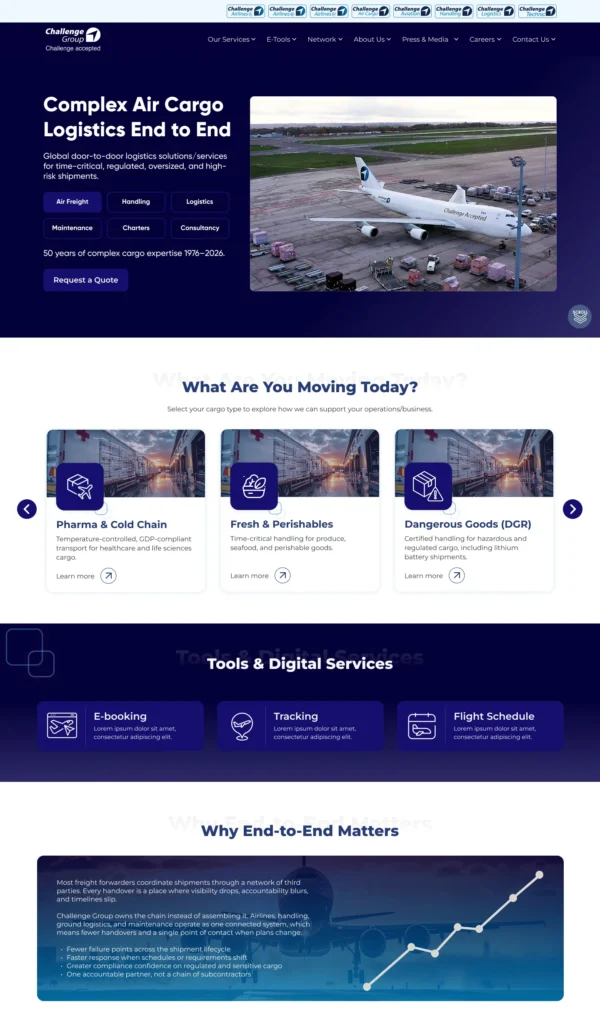
A complete Figma redesign and WordPress rebuild for a global air cargo operator – where the brief was simple: get it right in one shot, no room for revisions.
2+ Years Retained
Figma | WordPress | White Label
A leading Australian university research centre – operating in partnership with a government body – needed a bespoke, enterprise-grade digital platform to address psychosocial health and safety within the mining industry across Western Australia.
numbers we're comfortable putting our name behind - even when our name's not on it.
Every stat below traces back to a shipped, invisible build.