
If you’ve spent any time around AI product development in the last two years, you’ve heard the acronym RAG. Retrieval-Augmented Generation. It’s one of those technical terms that gets dropped in meetings, included in vendor proposals, and referenced in job descriptions — often without a clear, honest explanation of what it actually is or why it matters.
This article fixes that. Not with a textbook definition, but with a practical, plain-English explanation that tells you what RAG is, how it works, when you need it, and what it actually takes to build one properly. If you’re a founder, a product manager, or an agency evaluating AI projects for clients, this is the conceptual foundation you need before any technical conversation goes further.
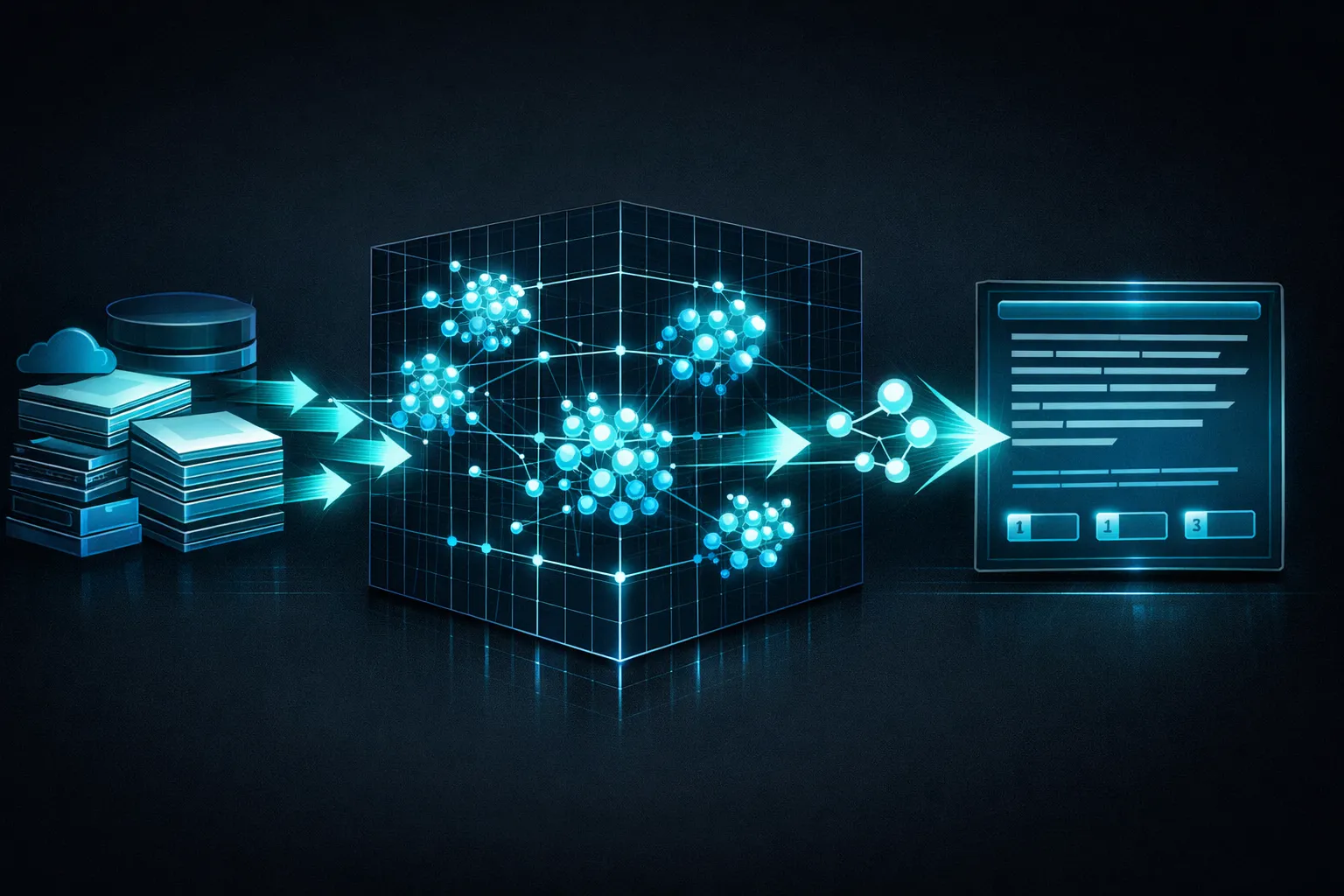
In one sentence: RAG is the architecture that allows an AI system to answer questions using your specific data — your documents, your database, your knowledge base — rather than relying solely on what the language model learned during training.
Why Language Models Need Help With Your Data
Large language models — GPT-4, Claude, Gemini and their peers — are trained on enormous datasets scraped from the public internet, books, and other sources. That training produces a model that knows a huge amount about the world in general. It can write, reason, summarise, and explain. It knows how photosynthesis works. It knows the history of the Roman Empire. It knows Python syntax and legal terminology and the plot of Shakespeare’s tragedies.
What it doesn’t know — what it cannot know — is anything specific to your business that wasn’t in that training data. It doesn’t know your product’s current pricing. It doesn’t know your internal policies. It doesn’t know the contents of the contracts you signed last quarter, the configuration docs your support team uses, or the client notes your account managers keep. And even if some of that information existed on the public internet during training, the model’s knowledge has a cutoff date — it doesn’t update dynamically as your business changes.
This is the problem RAG solves. It gives the language model access to your information at the moment a user asks a question — not baked into the model’s training, but retrieved fresh from your data sources and injected into the context the model uses to generate its response.
How RAG Actually Works — Step by Step
Step 1: Ingestion — Converting Your Content Into Searchable Form
The first stage of building a RAG system is taking your documents, knowledge base, database records, or other content sources and processing them into a form that can be searched semantically — not just by keyword, but by meaning.
This process involves splitting your content into chunks (passages, paragraphs, or structured sections, depending on the content type), then passing each chunk through an embedding model. An embedding model converts text into a numerical vector — a long list of numbers that represents the semantic meaning of that text in a high-dimensional space. Content with similar meanings produces similar vectors. Content with unrelated meanings produces vectors that are far apart in that space.
These vectors are stored in a vector database — a specialised data store designed for fast, high-dimensional similarity search. This becomes the searchable knowledge layer your AI draws from at query time.
Step 2: Retrieval — Finding What’s Relevant to Each Query
When a user submits a query — “what’s the cancellation policy for enterprise accounts?” or “which supplier has the best lead time for component X?” — the system doesn’t search for those exact words. It converts the query into a vector using the same embedding model, then searches the vector database for the chunks of content whose vectors are closest to the query vector.
Because this search operates on meaning rather than keywords, it finds relevant content even when the exact words don’t match. A query about “cancellation” finds content about “terminating a subscription” and “ending a contract.” A query about “delivery time” finds content about “lead time” and “fulfilment schedule.” This is the semantic search capability that keyword search cannot replicate — and it’s what makes RAG systems feel genuinely intelligent rather than merely fast.
Step 3: Augmentation — Building the Context for the LLM
The retrieved chunks — the most semantically relevant passages from your knowledge base — are assembled into a context block and passed to the language model alongside the user’s original query. The prompt structure looks something like this: “Here is relevant information from our knowledge base: [retrieved chunks]. Using only this information, answer the following question: [user query].”
This is the “augmentation” part of Retrieval-Augmented Generation. The model’s response is no longer generated purely from its training knowledge — it’s generated from the specific, retrieved context your system has provided. The model acts as a reasoning and language layer, not a knowledge store. The knowledge comes from your data.
Step 4: Generation — A Grounded, Contextual Response
With the right retrieved context in place, the language model generates a response that is specific to your data, current as of your last ingestion run, and citable — you can point back to the exact source passages the response was drawn from. This is qualitatively different from a standard LLM response, where the answer emerges from the model’s generalised training and cannot be traced to a specific source document.
The practical outcomes: fewer hallucinations, more accurate answers on domain-specific topics, and the ability to attribute every claim to a source — which matters enormously for use cases in legal, financial, medical, and compliance-sensitive contexts. This is why professional AI integration projects almost universally involve a RAG architecture as their core retrieval layer.
RAG vs Fine-Tuning: Why Most Businesses Choose RAG
The alternative to RAG for giving an LLM business-specific knowledge is fine-tuning — training the model further on your data so that knowledge is baked into its weights. Fine-tuning has its place, but for most business use cases, RAG is the more practical choice for three concrete reasons.
Updateability: When your data changes — new pricing, updated policies, new product documentation — a RAG system updates by re-ingesting the new content. The vector database is refreshed. Fine-tuning requires re-training the model, which is expensive and time-consuming. For businesses where data changes frequently, fine-tuning’s freshness lag is a serious problem.
Cost: Fine-tuning a capable foundation model costs real money and requires significant compute. Building a RAG pipeline on top of an API-accessible model is a software engineering project, not a machine learning training run. For most agencies and product teams, the economics strongly favour RAG.
Auditability: With RAG, you can inspect exactly what information the model was given before it generated a response. This is critical for regulated industries and for debugging when the AI gives a wrong answer. With fine-tuning, knowledge is diffused through the model’s weights in ways that are much harder to inspect and trace.
Where RAG Makes the Most Difference in Real Products
Customer-Facing Knowledge Bases and Support
Instead of a keyword search bar that returns approximate matches, a RAG-powered support interface understands what the user is actually asking and retrieves the most relevant documentation, regardless of whether the exact terminology matches. This directly reduces support ticket volume for “I couldn’t find the answer” queries — one of the highest-cost, lowest-value ticket categories for most SaaS businesses. When our AI integration engineering team builds these systems, the first measurable outcome is typically a 25–40% reduction in documentation-related support volume within 60 days of deployment.
Internal Knowledge Management
Enterprise teams produce enormous volumes of documentation — process guides, decision logs, project retrospectives, policy documents, meeting notes — that then become effectively inaccessible because no one can find anything in a shared drive with ten thousand files. A RAG system built on your internal knowledge base makes that institutional knowledge queryable in natural language. New team members can onboard faster. Senior team members stop being interrupted with questions their documentation already answers.
Compliance and Legal Research
Law firms, financial services companies, and compliance teams deal with large volumes of documents that must be queried precisely. RAG enables natural language search across contract libraries, regulatory documentation, and case files — returning relevant passages with citations, at a speed no manual search process can match. The data analytics capabilities connected to these systems create additional value: pattern recognition across contract terms, anomaly detection in compliance filings, frequency analysis across case types.
AI-Powered Product Features
For SaaS products, e-commerce platforms, and digital tools, RAG is the architecture behind intelligent search, personalised recommendations, contextual onboarding assistants, and AI-generated insights drawn from user-specific data. These are the features that make a product feel genuinely intelligent rather than generically AI-flavoured — and they require the kind of custom software development that embeds AI at the product’s core.
What Makes a RAG System Production-Ready
Building a RAG proof of concept that works in a demo takes a few days. Building one that works reliably in production — at scale, with real users, across edge cases — is a more serious engineering undertaking. The dimensions that separate a demo from a production system are consistently the same.
Chunking strategy: How you split your documents into chunks significantly affects retrieval quality. Too large and the retrieved chunks include irrelevant content that dilutes the model’s context. Too small and the chunks lack enough context to be useful. The right chunking strategy depends on the structure of your specific content and requires tuning against real queries.
Embedding model selection: Different embedding models have different strengths across domains. A model optimised for general text may perform poorly on highly technical, legal, or scientific content. Choosing and evaluating the right embedding model for your specific data domain is part of the architecture process, not a default setting.
Retrieval tuning: How many chunks do you retrieve? How do you handle the case where no chunk is confidently relevant? Do you use hybrid search — combining semantic and keyword retrieval — for better precision on specific terms? These are engineering decisions with measurable performance implications.
Context window management: LLMs have finite context windows. If you retrieve too many chunks, you exceed the context limit. If you retrieve too few, the model lacks sufficient information to answer well. Managing this balance — and handling the cases where a query requires more context than fits — requires deliberate architecture.
Monitoring and observability: A production RAG system needs to be observed. Which queries are failing to retrieve relevant results? Where is the model generating responses that don’t match the retrieved context? This requires logging, evaluation pipelines, and ongoing tuning — exactly the kind of post-deployment management that separates a system that stays good from one that degrades silently.
Is RAG Right for Your Project?
RAG is the right architecture when your AI system needs to answer questions using information that changes over time, is proprietary to your business, or is too specific to have been well-represented in a general model’s training data. That describes the majority of business AI use cases.
It is not the right architecture when your AI feature doesn’t need domain-specific knowledge — when general language model capability is genuinely sufficient. Pure creative writing tools, general coding assistants, and open-ended brainstorming features often fall into this category. Know your use case before committing to an architecture.
If you’re unsure which architecture your project needs, that’s a question worth resolving before any development starts. At NextEnvision Digital, architecture assessment is where every AI project begins — because the right architectural decision at the start is worth ten times the effort of correcting the wrong one mid-build. Book a discovery call and we’ll walk through your specific situation with you.
FAQs
Everything you need to know
What does RAG stand for?
RAG stands for Retrieval-Augmented Generation. It’s an AI architecture pattern that combines a retrieval system — which searches your specific data for relevant information — with a language model that uses that retrieved information to generate accurate, grounded responses.
How is RAG different from just giving the AI a long document?
Pasting a document into a chat context works for one-off queries on short documents, but it doesn’t scale. Vector-based RAG retrieves only the most relevant sections at query time, which means it works across thousands or millions of documents, stays within model context limits, and responds much faster. It also allows your knowledge base to be updated continuously without rebuilding the entire context.
Do I need a vector database to use RAG?
A vector database is the standard infrastructure for RAG at production scale. Options include Pinecone, Weaviate, Qdrant, pgvector, and others — each with different performance, cost, and hosting characteristics. The right choice depends on your data volume, query load, and infrastructure constraints. Some smaller implementations use in-memory vector search for simpler use cases, but for any serious production system, a dedicated vector database is the appropriate choice.
How long does it take to build a RAG system?
A focused RAG implementation — defined scope, clean data sources, clear use case — typically takes four to eight weeks from architecture through production deployment. Broader scope, messy or unstructured data, or complex permission requirements extend that timeline. A proof-of-concept can be built in days; a production-ready system takes significantly longer because the work that makes it reliable — chunking tuning, retrieval evaluation, monitoring setup — takes time to do properly.
Can RAG work with structured data like databases, not just documents?
Yes, though the implementation is different. For structured data, retrieval often works better through a text-to-SQL approach — where the AI generates database queries from natural language and retrieves structured results — than through vector-based document retrieval. Many production AI systems combine both approaches: RAG for unstructured content, text-to-SQL for structured data queries, with a unified interface for the user.