
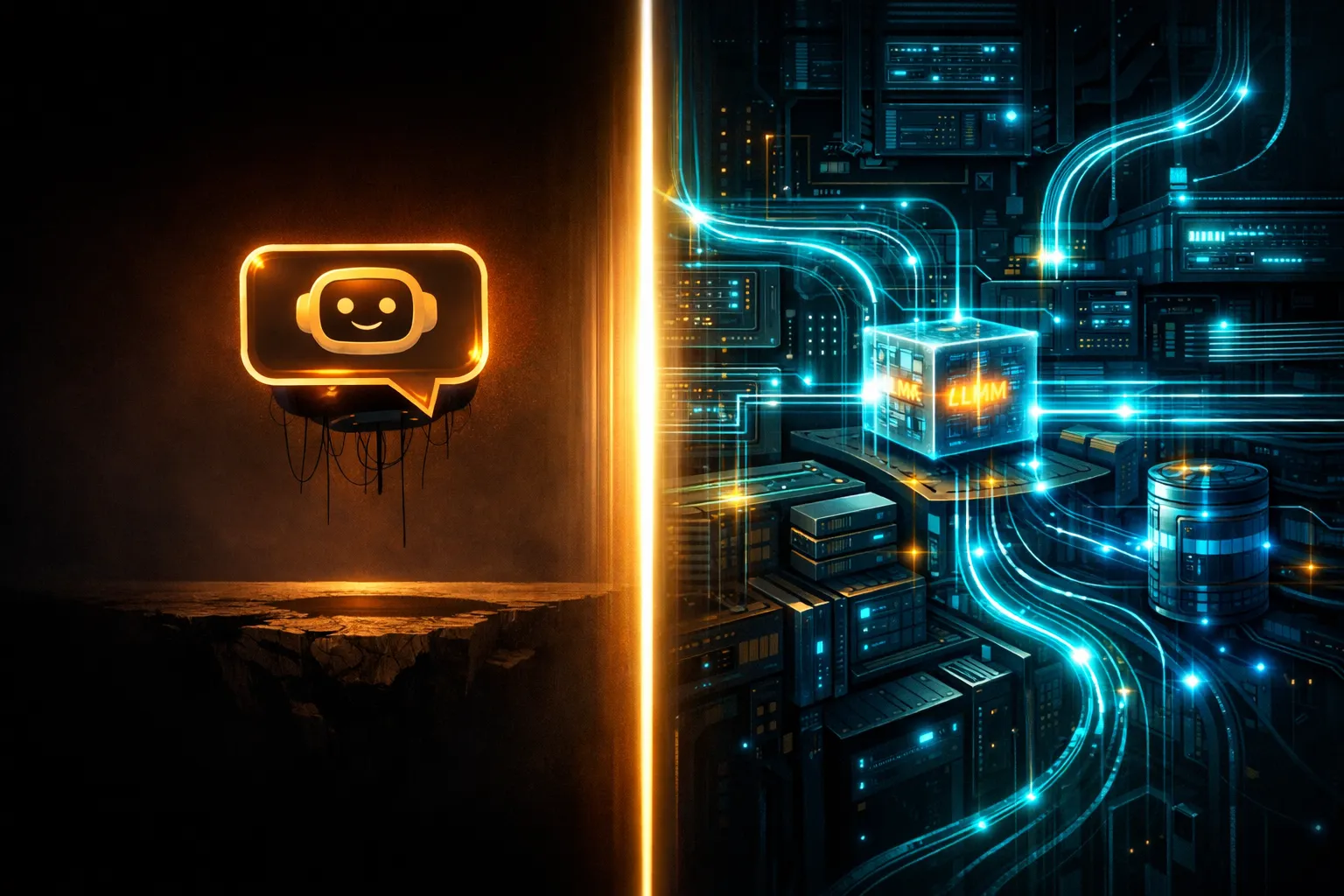
A lot of businesses shipped a chatbot last year and called it their AI strategy. It wasn’t then. It isn’t now. And if your product roadmap still treats them as equivalent, the gap between you and competitors who’ve done this properly is widening faster than most leadership teams realise.
This isn’t a criticism — it’s context. The AI tooling available eighteen months ago genuinely incentivised the chatbot-first approach. Wrapper products were everywhere. Getting an LLM talking to your users was fast, cheap, and impressive in a demo. The problem only became visible later, when the chatbot started confidently giving wrong answers, forgot what it said three messages ago, knew nothing about your actual product, and generated a wave of support tickets from confused users who’d trusted it.
The short version: A chatbot is a user interface. AI integration is an architectural decision. One sits on top of your product. The other is woven into it. These are not different points on the same spectrum — they are different categories of engineering work entirely.
What a Chatbot Actually Is
Strip away the marketing language and a typical AI chatbot is straightforward: a user interface that takes a text input, passes it to an LLM API with a system prompt, and returns the model’s response. The system prompt might say something like “You are a helpful assistant for [Company Name]. Be professional and friendly.” The model responds based on its training data. Nothing more.
In this setup, the AI knows nothing about your business beyond what you’ve put in the system prompt. It doesn’t know your product’s current pricing. It doesn’t know which features are in beta. It doesn’t know the specific contents of your documentation, your policies, or your users’ account histories. It knows what every user of that model knows — which is general information up to a training cutoff, processed through a generic instruction.
The consequences are predictable: hallucinated answers, confident statements that contradict your actual documentation, and an AI that gives every user the same generic response regardless of their context or history with your product.
Where the Illusion Breaks Down
Demos are controlled environments. The person running the demo knows what questions to ask, avoids the edge cases, and presents the output under favourable conditions. In production, real users are less cooperative. They ask questions the system prompt didn’t anticipate. They reference things they did last week in your platform. They ask for specifics — prices, dates, configuration details — that the model either doesn’t know or gets wrong.
This is where chatbots fail publicly, and where the business damage accumulates. A user who receives a confidently wrong answer from your AI doesn’t think “the AI got it wrong.” They think “this company doesn’t know what they’re talking about.” The trust damage is attributed to the brand, not the model.
The businesses that have moved past this phase share one characteristic: they stopped treating AI as a UI layer and started treating it as an infrastructure concern. That shift is what separates a chatbot from real AI integration.
What Real AI Integration Actually Requires
Connection to Your Actual Data
The first thing that separates a properly integrated AI system from a chatbot is data connectivity. A real AI integration doesn’t answer from general training knowledge — it retrieves answers from your specific information: your documentation, your product database, your user account data, your historical records, your internal knowledge base.
This requires building a retrieval layer — typically using a vector database and an embedding model — that can semantically match a user’s query against your actual content and pass the most relevant context to the LLM at inference time. This is called Retrieval-Augmented Generation (RAG), and it is the architectural foundation of almost every AI feature that works reliably in production. It requires custom software development — not a third-party plugin.
Memory and Context Management
Language models are stateless by default. Each API call starts fresh. Building a system where AI maintains meaningful context across a user’s session, across multiple sessions, or across a long-running workflow requires deliberate engineering: a conversation memory layer, a context window management system, and decisions about what to store, how long to store it, and how to surface it at the right moment.
Without this, every AI interaction starts from zero. Users find themselves re-explaining their situation. The AI gives inconsistent answers because it literally has no memory of prior exchanges. The experience degrades quickly, and users stop engaging with the feature.
Deterministic Behaviour at Scale
LLMs are probabilistic. Their outputs vary. In a consumer chatbot, some variability is acceptable. In a business product — where your AI is making statements about your pricing, your legal terms, your product capabilities, or your service guarantees — variability is a liability. Real AI integration includes guardrails: output validation, fallback logic, confidence thresholds, and human escalation paths for queries the system cannot answer reliably.
Building these guardrails is not glamorous work. It doesn’t show up in demos. But it is what determines whether your AI feature holds up when a client’s CEO uses it, or when a user shares a screenshot of a wrong answer on social media.
Integration With Your Existing Infrastructure
Proper AI integration means the AI feature lives inside your codebase, not alongside it. It respects your authentication layer, your permission model, your data governance rules, and your API versioning. It deploys through your existing DevOps and cloud infrastructure pipeline. It is monitored alongside your other services. When it breaks — and at some point, every system breaks — your team can diagnose and fix it using the same tools they use for the rest of the product.
This is architecturally different from a third-party chatbot embedded via JavaScript snippet, which lives outside your system, is opaque to your monitoring tooling, and breaks in ways your engineering team cannot inspect.
Three Signs Your AI Feature Is Actually Just a Chatbot
It Answers the Same Way Regardless of Who’s Asking
If your AI gives an identical response to a first-time user and a seven-year customer with a detailed history on your platform, it is not integrated — it’s bolted on. A properly integrated AI knows who it’s talking to and answers accordingly. Account context, usage history, tier level, geographic location — all of this should inform the response when relevant.
It Confidently Answers Questions It Shouldn’t Be Able to Answer
If your AI confidently tells users things about your product that are wrong — outdated pricing, features that don’t exist, policies that have changed — it is hallucinating from general training data rather than retrieving from your actual knowledge base. This is not a model quality problem. It is an architecture problem. The fix is retrieval, not a better prompt.
It Lives Outside Your Codebase
If your AI feature can be removed without touching a single line of your product’s code, it is not integrated. It is a widget. Widgets have their place — for simple FAQ deflection or basic triage, they can be perfectly appropriate. But they are not AI integration, and they are not what your product needs if you’re building something designed to last.
The Business Cost of Getting This Wrong
The direct cost of shipping a chatbot-as-strategy is easy to see in hindsight: support ticket volume from users misled by incorrect AI answers, developer time spent patching prompt instructions to fix hallucinations that keep recurring, the rebuild cost when leadership finally recognises the system isn’t fixable and commissions a proper integration.
The indirect cost is harder to quantify but more damaging: the eroded user trust, the competitive disadvantage relative to products whose AI features actually work, and the internal confidence problem that makes the next AI initiative harder to fund because the first one didn’t deliver.
For agencies building AI features for clients, this plays out at the client relationship level. A chatbot that fails in production damages the agency’s credibility. A properly engineered AI feature that works reliably creates the kind of client trust that generates long-term retainer work and referrals. The commercial case for getting the engineering right is as strong as the technical one. This is precisely why white-label AI development partnerships that bring genuine engineering depth matter so much for agencies who want to deliver real outcomes.
What to Do Instead
The starting point is an honest assessment of what your AI feature actually needs to know, remember, and do — and how reliably it needs to do it.
If the answer is “answer simple FAQs about our general product category, with occasional inaccuracies acceptable,” a well-configured chatbot may genuinely be sufficient. But if the answer is “know our specific product, know this specific user, give answers we’d stake our reputation on” — that’s an integration project, and it needs to be scoped and resourced accordingly.
The businesses winning with AI right now are not the ones who shipped the most AI features. They’re the ones who shipped AI features that actually work — that users rely on, return to, and recommend. That outcome requires AI integration engineering, not a chatbot widget with a confident system prompt.
At NextEnvision Digital, we build the second kind. If your current AI feature belongs in the first category and you know it needs to graduate, book a discovery call and we’ll give you an honest assessment of what a proper integration would look like for your product.
FAQs
Everything you need to know
What is the difference between an AI chatbot and AI integration?
An AI chatbot is a user interface layer — it passes user messages to an LLM and returns responses, typically without access to your business’s specific data. AI integration embeds AI capabilities directly into your product architecture, connected to your real data, your user context, and your existing infrastructure. The chatbot sits on top of your product. The integration is inside it.
Can a chatbot be upgraded into a real AI integration?
In some cases, yes — but it typically requires rebuilding the data layer rather than iterating on the existing chatbot. If the current system has no retrieval architecture, no memory layer, and no integration with your product’s data, adding those things is effectively building a new system. The interface may look similar from a user’s perspective, but the underlying engineering is fundamentally different.
How long does a proper AI integration project take?
For a focused scope — one AI feature, well-defined data sources, clear use case — a properly engineered integration typically takes eight to twelve weeks from discovery through production deployment. Broader scope, more complex data architecture, or products with significant existing technical debt extend that timeline. Projects that try to compress this timeline by skipping architecture or testing almost always cost more to fix than they saved upfront.
Is AI integration worth it for smaller businesses or early-stage products?
It depends on what the AI feature needs to do. If it’s genuinely a simple FAQ assistant and accuracy is not critical, a well-configured third-party chatbot is a reasonable starting point. If the AI feature is intended to be a meaningful part of your user experience — something users will rely on for accurate, contextual information — then the investment in proper integration is justified from early on, because the cost of rebuilding a chatbot that fails in production is higher than building it right the first time.