
Every business conversation about AI eventually arrives at the same crossroads: do we automate our processes, or do we integrate AI into our product? Most businesses answer this question based on budget, timeline, or the last vendor pitch they heard — not on a clear understanding of what each approach actually delivers. That’s where the expensive mistakes start.
The distinction matters more than most teams realise. AI automation and AI integration are fundamentally different in scope, architecture, cost, and return. Treating them as interchangeable — or choosing one when you need the other — produces systems that underdeliver, underperform, and often require a full rebuild within eighteen months.
This guide is for decision-makers who want to understand the difference clearly, evaluate their own situation honestly, and make the right call the first time.
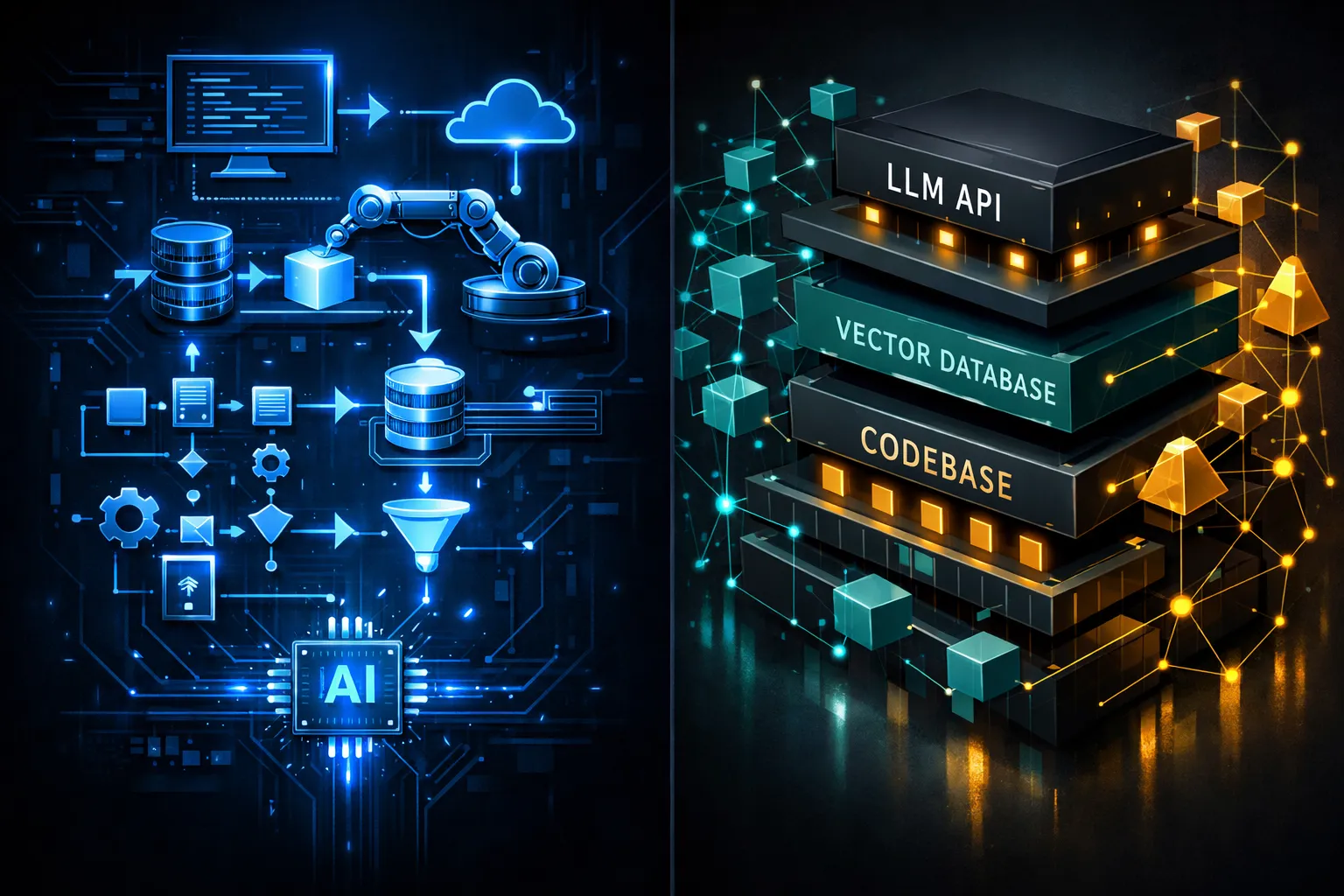
Quick answer: AI automation replaces repetitive, rule-based tasks with AI-assisted workflows — document processing, approval routing, notifications, reporting. AI integration embeds AI capabilities directly into your product or software infrastructure — LLM-powered features, intelligent search, recommendation engines, semantic classification. You may need both. You almost certainly don’t need them at the same time, in the same project, with the same team.
The Problem With How Businesses Are Making This Decision
When AI entered the mainstream business conversation, it arrived wearing two masks simultaneously. Marketing positioned it as something you plug in — drag-and-drop automation, chatbots you set up in an afternoon, workflows you build on no-code platforms. Engineering positioned it as something you architect — models, embeddings, pipelines, APIs. Both framings were accurate for their respective use cases. The problem is that most businesses never clearly separated them.
The result is a market full of businesses that have invested in Zapier workflows when they needed a trained retrieval system, or commissioned an AI integration project when a well-configured automation sequence would have solved the problem in a week. Neither outcome is good. Over-engineering a simple process is wasteful. Under-engineering a complex one is catastrophic.
The confusion is compounded by vendors who have every commercial incentive to upsell. An automation platform will tell you automation is the answer. An AI agency pitching integration work will tell you you need integration. What neither will tell you, plainly, is how to distinguish between a problem that deserves automation and one that requires proper AI integration engineering.
That’s what this article does.
Defining Each Approach Without the Marketing Language
What AI Automation Actually Is
AI automation is the application of AI to streamline or eliminate manual, repetitive processes. The work involved is real and valuable — but its defining characteristic is that it acts on defined triggers, follows configured logic, and operates within a boundary you set at build time. The AI component typically handles variation within known patterns: classifying an incoming document, extracting fields from a form, routing a request based on content, generating a report from structured data.
Tools like n8n, Make (formerly Integromat), and custom API orchestration are common implementation platforms. The processes that benefit most are ones your team currently does manually and repeatedly: invoice processing, lead qualification and routing, client onboarding sequences, data extraction from unstructured documents, internal approval workflows. When these processes run ten, fifty, or five hundred times a day, automation returns its investment quickly and predictably.
The ceiling of AI automation is its boundary. It handles what it was configured to handle. When inputs fall outside the configured patterns — when business logic becomes complex, when volume spikes, when data becomes sensitive or irregular — no-code and low-code automation reaches its limit fast.
What AI Integration Actually Is
AI integration is the engineering process of embedding AI capabilities directly into your software product or existing infrastructure. This is not a workflow layer sitting above your system. It is AI woven into the system itself — into the codebase, the data pipeline, the API layer, the product experience.
Examples include an intelligent search interface that retrieves semantically relevant results from a product catalogue, a document analysis feature that understands context rather than just parsing fields, a recommendation engine that learns from user behaviour and serves personalised results, or a conversational assistant with genuine memory that connects to your actual data. These are not automations. They are product features. They require bespoke software architecture, LLM API integration, prompt engineering, retrieval systems, and production-grade error handling.
Done properly, professional AI integration changes what your product is capable of, not just what it does automatically. That’s a meaningfully different outcome — and it requires meaningfully different engineering.
Where the ROI Sits in Each Approach
The ROI of AI Automation: Speed and Cost Reduction
AI automation’s return on investment is direct and measurable. You identify a process that consumes X hours of human time per week, automate it, and recover those hours. The calculation is straightforward. For most businesses, the payback period on a well-scoped automation project is three to six months. The ongoing value is operational — reduced error rates, faster processing times, lower cost-per-transaction, and the ability to scale the process without adding headcount proportionally.
The important qualifier is “well-scoped.” Automation projects fail when the process being automated isn’t actually well-defined, when the inputs are too variable for configured logic to handle, or when the problem is fundamentally one of product capability rather than operational efficiency. Automating a broken process makes a broken process faster. It doesn’t fix it.
The ROI of AI Integration: Capability and Competitive Differentiation
The return on AI integration is less immediate but structurally more significant. When AI is integrated properly into a product, it changes the product’s competitive position. Users don’t think of it as “AI” — they think of it as the product being smarter, faster, and more useful than alternatives. That perception drives retention, increases willingness to pay, and creates a compounding advantage as the integrated AI learns from more usage data over time.
For businesses working with AI-driven analytics and intelligence at the product level, the integration ROI often shows up in conversion rates, churn reduction, and net revenue retention — not just in operational cost savings. It’s harder to model upfront and slower to materialise, but the ceiling is far higher.
The ROI of Getting the Decision Wrong
This one is rarely discussed but frequently experienced. A business that invests in automation when they needed integration ends up with a workflow layer that collapses the moment their use case grows more complex. Rebuilding it as a proper integration project costs two to three times what starting correctly would have. A business that commissions a full AI integration project when automation would have served them spends six figures on engineering for a problem a five-hundred-dollar-a-month tool could have solved. Neither mistake is rare.
Industry Use Cases: Automation vs Integration in Practice
Use Case 1 — Professional Services Firm: Document Handling
A mid-sized accounting firm processes hundreds of client documents weekly — tax forms, financial statements, supporting schedules. Their team manually extracts data from each document, checks it against prior-year records, flags discrepancies, and routes exceptions for partner review.
Right answer: AI automation. The process is defined, repetitive, and high-volume. The inputs, while varied in format, follow known document structures. An automation pipeline using document AI for extraction, rules-based validation, and exception routing solves this problem cleanly. No custom LLM integration required. No complex retrieval architecture. A well-engineered automation sequence, connected to their existing document management system, delivers measurable ROI within two months.
Use Case 2 — SaaS Platform: Intelligent Search
A B2B SaaS company has a product with a large knowledge base — thousands of articles, configuration guides, API documentation. Their users currently use keyword search. They find approximate matches, or nothing. Support ticket volume for “I couldn’t find the answer” runs at 30% of total tickets.
Right answer: AI integration. Keyword search cannot solve this. What they need is semantic search — an AI-powered retrieval system that understands the meaning of a user’s query and returns the most contextually relevant results, regardless of exact keyword match. This requires embedding their knowledge base, building a vector retrieval layer, integrating it into their existing product infrastructure, and engineering a prompt layer that returns clean, cited answers. This is not automation. It is a product feature that requires proper AI integration engineering.
Use Case 3 — E-Commerce: Order Processing vs Personalisation
An e-commerce business has two problems. First, their order processing workflow requires manual intervention at multiple steps — fraud flags reviewed by hand, shipping exceptions managed by email, return approvals handled one-by-one. Second, their product recommendations are rule-based and static, driving a conversion rate significantly below industry benchmarks.
Right answer: Both — in sequence. The order processing problem is an automation problem. Each manual step has a defined trigger, a decision rule, and a clear output. An automation layer handles this cleanly. The recommendations problem is an integration problem. Meaningful personalisation requires a machine learning layer connected to behavioural and transactional data, integrated into the product’s API layer. Trying to solve personalisation with an automation tool produces a rule-based approximation that doesn’t improve over time. Trying to solve order processing with an LLM integration project is massive overkill. Both problems deserve the right solution — and they should be sequenced, not conflated.
Use Case 4 — Digital Marketing Agency: Client Reporting vs AI Content Tools
A digital marketing agency wants to improve two things: their client reporting process (currently manual, eight hours per client per month) and their content production capability (they want to offer AI-assisted content creation as a service).
Right answer: Automation for reporting, integration for the content tool. Reporting is a clearly defined process with structured data inputs — campaign metrics, channel data, performance benchmarks. Automation, connected to their clients’ ad platforms and analytics tools via their business intelligence stack, produces the reports automatically. The content tool is different — it needs to understand brand voice, maintain context across content pieces, connect to brand guidelines, and produce outputs tailored to specific audiences. That’s an integration project, not an automation workflow.
Use Case 5 — Healthcare Platform: Appointment Management vs Clinical Decision Support
A digital health platform wants to automate appointment scheduling, reminders, and follow-up communications. They also want to explore clinical decision support — surfacing relevant patient history and evidence-based recommendations during consultations.
Right answer: Automation for scheduling, and careful, engineered AI integration for clinical support. Scheduling automation is routine. The clinical decision support system, by contrast, requires medical-grade retrieval architecture, strict context management, safety guardrails, and deep integration with clinical data sources — work that sits firmly in the custom software development and AI engineering category. The stakes demand it.
The Decision Framework: How to Know Which One You Need
- Map the process precisely. Write down what happens, step by step, including every decision point, every exception, and every data source involved. If you cannot write it down clearly, it is not ready to be automated — and may not be the right candidate for automation at all.
- Test the ceiling of your current tool. If you already use no-code automation tools, push them to their limit on this problem. Where do they break? If they break on volume or speed, you may need better automation infrastructure. If they break on intelligence — on context, understanding, nuance, or learning — you need AI integration.
- Ask whether the output changes the product or just the process. If the AI capability would make your product fundamentally more useful to users, it belongs inside the product — which means integration. If it would make an internal or operational process more efficient, automation is likely the right layer.
- Evaluate data complexity. Automation works well with structured or semi-structured data in defined formats. The moment you need AI to understand meaning — across unstructured documents, natural language inputs, multimodal content, or domain-specific context — you are in integration territory. Your data analytics and architecture team should be part of this evaluation.
- Assess volume and variability together. High volume plus low variability equals strong automation candidate. High variability — even at lower volume — is a signal that you need AI reasoning built into the system, not a workflow that routes based on fixed conditions.
- Consider infrastructure dependency. Integration projects live inside your codebase and infrastructure. They require cloud infrastructure decisions, deployment pipelines, API versioning, and ongoing maintenance. Automation tools are typically more loosely coupled. If your team cannot support the infrastructure weight of an integrated AI system, start with automation and build toward integration as capability grows.
Automation vs Integration: Direct Comparison
| Factor | AI Automation | AI Integration |
|---|---|---|
| Primary purpose | Eliminate or streamline manual, repetitive processes | Add AI intelligence as a native product or system capability |
| Implementation location | Workflow layer above existing systems | Inside the codebase and infrastructure |
| Typical tools | n8n, Make, Zapier, custom API orchestration | OpenAI, Claude, Gemini APIs, vector databases, RAG pipelines |
| Time to value | Weeks to months | Months to quarters |
| Engineering depth required | Low to medium | High — requires senior AI and backend engineering |
| Data requirements | Structured or semi-structured, defined formats | Can handle unstructured data, natural language, multimodal inputs |
| Scales with complexity? | Reaches a ceiling; breaks on high variability | Designed for complexity; improves with more context and data |
| ROI profile | Fast, measurable cost reduction | Slower, larger, competitive and product-level advantage |
| Maintenance overhead | Moderate — workflow adjustments as business rules change | Higher — model updates, prompt maintenance, retrieval tuning |
| Right for | Operational efficiency, internal process improvement | Product differentiation, user experience, intelligent features |
Common Mistakes That Cost Businesses the Most
Mistake 1: Automating a Process That Hasn’t Been Defined First
Automation enforces process. If the underlying process is unclear, inconsistent, or debated internally, automation makes those problems permanent and harder to fix. The discipline of mapping a process well enough to automate it often reveals that the process itself needs redesigning. Don’t skip that step. A well-engineered automation built on a poorly defined process is a fast machine doing the wrong thing at scale.
Mistake 2: Using Integration to Solve an Automation Problem
This is the most expensive category of AI mistake. A business that commissions a full LLM integration project — with vector databases, custom embeddings, retrieval architecture — to solve a problem that a well-configured n8n workflow could handle in a week has paid for six to twelve weeks of engineering time unnecessarily. It happens when decision-makers conflate sophistication with suitability. Simpler is correct when simpler solves the problem.
Mistake 3: Treating AI Integration as a One-Time Project
AI integration is not a project with a completion date. Models update. Prompt logic drifts as usage patterns change. Retrieval quality degrades as data grows. APIs deprecate. Businesses that treat their AI integration as “done” after deployment find it quietly deteriorating in production with no one responsible for its health. Build post-deployment management into your plan before you start — not as an afterthought.
Mistake 4: Building Without a Data Strategy
Both automation and integration depend on data — but integration is existentially dependent on it. An AI integration project without a clear data strategy is building intelligence on a foundation that can’t support it. Before any integration work starts, the data architecture needs to be sound: clean, structured, accessible, and governable. Agencies and founders building with AI who skip this step create systems that behave unpredictably in production.
Mistake 5: Confusing a Proof of Concept with a Production System
Prototypes and demos are easy to build. They work under controlled conditions, with limited inputs, against small datasets. Production AI systems are different — they need to handle edge cases, operate under load, manage errors gracefully, and behave predictably when users do unexpected things. The jump from “our demo works” to “this runs reliably in production” is where most AI projects stall. Engineering rigour at the architecture stage — not just at the demo stage — is what separates the real-world implementations that succeed from the ones that quietly get shelved.
Future Direction: How the Line Between Automation and Integration Is Shifting
Agentic AI systems are beginning to blur the boundary that this article has drawn clearly. In an agentic architecture, AI doesn’t just respond to a trigger or answer a query — it plans, executes a sequence of actions, uses tools, evaluates results, and iterates. This sits somewhere between automation and integration: it has the autonomous execution of automation and the contextual intelligence of integration, combined into systems that can handle genuinely complex, multi-step work without a human in the loop at each step.
For businesses planning their AI strategy beyond the next twelve months, agentic architecture is the direction to understand. The businesses that have built solid automation infrastructure and clean AI integration foundations will be best positioned to add agentic capability as the tooling matures. Those that have neither — or that have built the wrong thing for the wrong reason — will face a steeper rebuild path.
The decisions you make now about automation vs integration are not just tactical. They shape what’s possible for your product and your operations in the years ahead.
Are You Ready to Make the Right Call? A Self-Assessment
- You have mapped your target processes in enough detail to identify every decision point, exception, and data source involved
- You understand whether your problem is one of operational efficiency (automation) or product capability (integration)
- You have evaluated no-code and low-code tools against your specific problem and know where their ceiling is
- Your data is structured, clean, and accessible enough to feed the AI system you’re planning to build
- You have senior engineering resource allocated — or an engineering partner identified — who understands AI architecture, not just automation tooling
- You have a post-deployment maintenance plan in place before you start, not as an afterthought
- Your team understands the timeline and ROI profile of the approach you’re choosing, and leadership expectations are aligned with those realities
- You have clarity on data governance, privacy obligations, and how AI-generated outputs will be monitored and validated in production
Getting the Architecture Right From the Start
The businesses that extract real, lasting value from AI are not the ones that moved fastest. They’re the ones that moved correctly — that diagnosed their problem accurately, chose the right approach, and engineered it with the rigour the approach demands.
Automation and AI integration are both legitimate, powerful, and valuable. They are not interchangeable. The decisions made at the architecture stage — before any code is written or any workflow is configured — determine whether your AI investment delivers a competitive return or becomes a case study in what not to do.
At NextEnvision Digital, we work with businesses and agencies at exactly this decision point. Our AI integration services cover every tier — from intelligent automation to production-grade AI engineering — and we are engineers first. We help you diagnose the problem correctly, design the right architecture, and build it in a way that holds up in production and scales as your business grows. Whether you’re a white-label AI development partner for your clients, or an organisation building AI capability into your own product, the starting point is the same: getting the decision right before you build. Book a discovery call and we’ll give you a straight assessment of which approach your situation actually needs.
Frequently Asked Questions
What is the main difference between AI automation and AI integration?
AI automation applies AI to streamline or remove repetitive manual processes — document processing, approval routing, data extraction, reporting. It operates above your existing systems as a workflow layer. AI integration embeds AI capabilities directly inside your software product or infrastructure — as features like intelligent search, recommendation engines, or LLM-powered interfaces. Automation improves operational efficiency. Integration changes what your product is capable of. Both are valuable; they solve different categories of problem.
How do I know if my business needs AI automation or AI integration?
Start by identifying where the problem lives. If your team spends significant time on repetitive, rule-based processes — the same task performed many times a day with structured inputs and defined outputs — automation is almost certainly the right approach. If the problem is that your product doesn’t understand context, can’t handle unstructured information, or needs to get smarter over time, that points to integration. The clearest diagnostic question is: am I trying to improve an internal process, or am I trying to make my product more intelligent? The former is automation. The latter is integration.
Can a business use both AI automation and AI integration at the same time?
Yes — and many mature businesses do. The practical recommendation is to sequence them rather than pursue both simultaneously. Automation projects are faster and return value quickly; they also free up operational budget that can be reinvested in the longer-timeline integration work. Running both workstreams in parallel with the same team typically results in both being executed poorly, because the engineering skills and attention each requires are different. Sequence them deliberately, with automation typically coming first unless there’s a compelling competitive reason to prioritise integration.
How long does a proper AI integration project take to complete?
A well-scoped AI integration project — one that includes discovery, architecture design, build, testing, and production deployment — typically runs eight to sixteen weeks for a focused, defined scope. Larger projects involving custom RAG pipelines, fine-tuned models, or complex data architecture can run longer. Projects that try to skip the discovery and architecture phases frequently take longer in total, because they encounter fundamental issues mid-build that require redesign. The most common reason AI integration projects overrun is insufficient architecture definition at the start, not technical difficulty during the build.
Is AI automation suitable for sensitive business data?
It depends on how the automation is configured and which platforms are used. No-code and low-code automation tools typically route data through third-party cloud infrastructure, which requires careful review against your data governance and privacy obligations — particularly for financial, legal, or health-related data. Custom API orchestration built on your own infrastructure avoids this by keeping data within your controlled environment. Before automating any process involving sensitive data, map the data flow completely and validate it against your compliance requirements. This is a configuration and governance decision, not a reason to avoid automation entirely.
What makes an AI integration project fail in production?
The most common causes are: building on a poor data foundation (AI systems are only as good as the data they reason from), insufficient testing against real-world edge cases rather than controlled demos, no observability or monitoring built into the deployed system, and treating deployment as the finish line rather than the start of the maintenance lifecycle. A secondary category of failure comes from architectural decisions made under time pressure — choosing a technically expedient approach that works at demo scale but breaks under production load. Proper discovery and architecture design at the start of the project eliminates most of these risks.
Do agencies need to choose between offering AI automation services and AI integration services to clients?
No — and in fact, agencies that can offer both are significantly better positioned commercially. Most client engagements start with a process problem that automation solves quickly, building trust and demonstrating ROI. The integration conversation follows naturally once the client has experienced what AI can do for their operations and is ready to think about what it can do for their product. The challenge for agencies is having the technical depth to deliver both well — automation tooling and LLM integration engineering are different disciplines, and claiming to do both without the team to support it creates delivery risk. Building or partnering for genuine depth in both areas is the right model.